When the second-generation Volvo XC90 debuted over a decade ago, it was a revelation of Scandinavian minimalism that made the contemporary German luxury establishment look like a collection of over-buttoned, anxieties-on-wheels. But here we are, and Volvo is still selling the exact same platform, wrapped in a fresh layer of cosmetic mascara and anchored by the T8 plug-in hybrid powertrain. What you find isn’t a seamless eco-warrior, but a fascinatingly complex, heavy mechanical compromise that proves making a mature chassis dance to the tune of modern electrification requires more than just a crystal shift knob and a prayer.


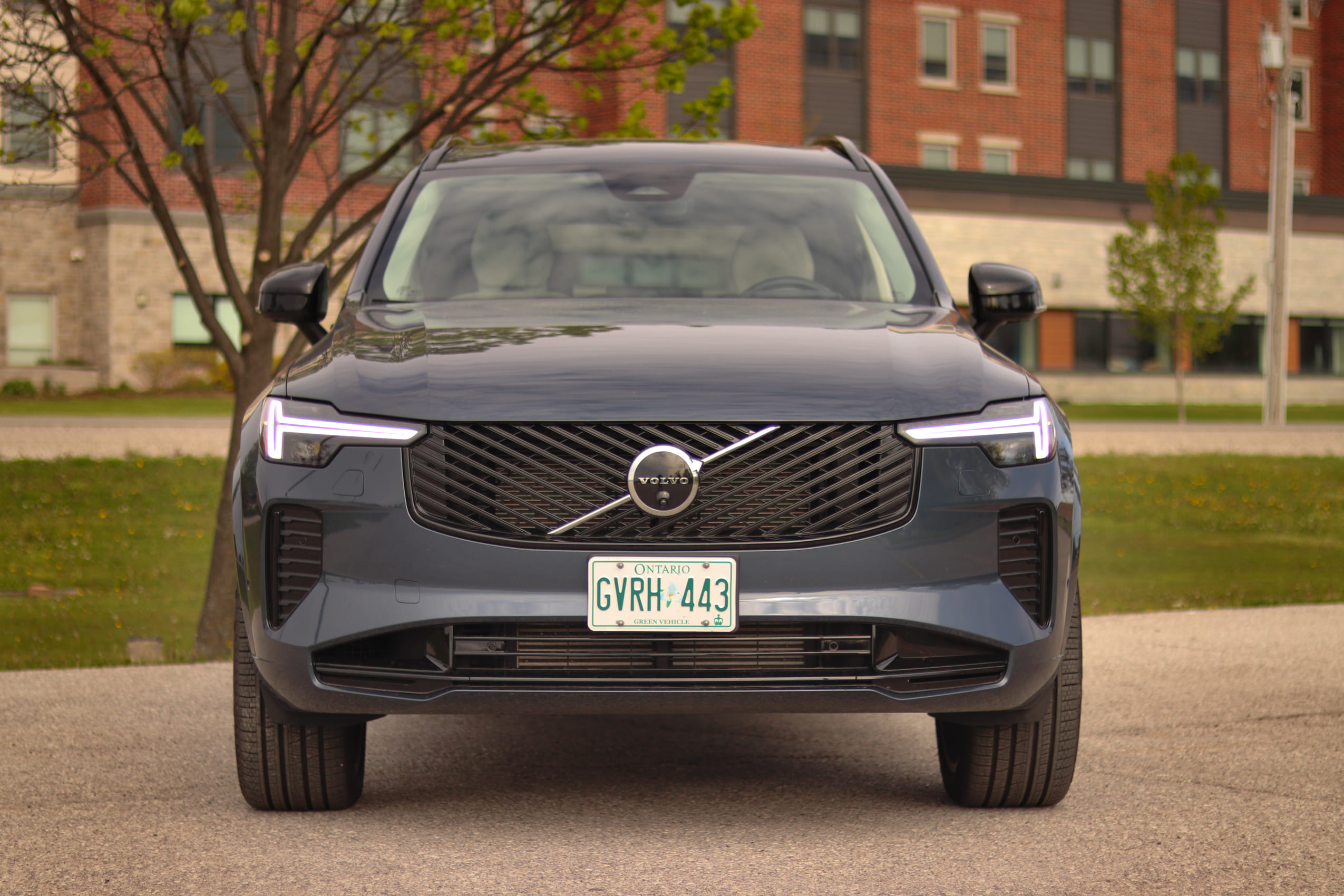


To understand the exterior of the updated XC90, you have to realize that Volvo is currently trapped in an existential design purgatory. They desperately want to be a pure electric vehicle company, but buyers aren’t cooperating. So, to keep their oldest and most profitable cash cow breathing, they’ve given it a facelift that tries to copy their newest EVs—with fascinatingly mixed results.
Step to the front, and the changes are impossible to miss. The familiar, proud chrome waterfall grille has been tossed into the recycling bin, replaced by a strange, flat, asymmetrical diagonal-slat pattern that sits nearly flush with the bodywork. It looks less like a traditional luxury intake and more like an architectural air vent you’d find inside an upscale Oslo dental clinic. Flanking this new nose are heavily slimmed-down “Thor’s Hammer” LED headlights, pinched tightly to match the brand’s current design language. The hood has been resculpted, flowing down into a smoothed-over front bumper that completely ditches the old model’s rugged, upright jawline. The result is a nose that looks undeniably modern, yet somehow more melted and less assertive than the handsome brick it replaces.
Walk around to the side profile, and you realize where the budget ran out. Aside from some enormous new diamond-cut wheel designs that range all the way up to a ride-ruining 22 inches, the sheet metal is identical to the car you saw in showrooms a decade ago. It still possesses that beautifully upright, anti-coupe-SUV silhouette—a gloriously glass-heavy greenhouse that prioritizes actual headroom for human beings over a sweeping, useless roofline. It’s an honest, timeless shape, but the decades-old door skins look a little surreal sandwiched between the ultra-modern nose and the refreshed tail.
Around back, the revisions are much more conservative. The iconic, vertically stacked taillights—a Volvo signature since the days of late-90s station wagons—remain fully intact, though they’ve been treated to a heavy, dark-tinted lens aesthetic. Below them, the rear bumper has been smoothed out to hide any evidence of tailpipes, a polite piece of visual deception meant to remind you that you bought the one with the charging port. It’s still an incredibly elegant machine from the rear three-quarter view, but the overall execution feels less like a cohesive new vehicle and more like a brilliant piece of historic preservation. Volvo has managed to make a mature platform look contemporary, but you can only smooth out the wrinkles so many times before the underlying age begins to show.


Climb inside, and you’re instantly greeted by the ultimate triumph of Swedish aesthetic stubbornness over everyday human reality.
Volvo calls this interior design language “Scandi-lux.” It’s an environment of staggering material diversity—matte-finish open-pore wood that actually feels like a tree, real stitched leather, and a glowing Orrefors crystal gear selector that looks like it belongs in a velvet-lined case at Nordstrom. The build quality is genuinely exceptional; closing the door feels like sealing the hatch on a nuclear submarine. If you are judging this cabin strictly as a minimalist architectural achievement, it is a flawless victory.
But if you judge it as a machine meant to transport a modern family and their assorted lifestyle debris, the cracks begin to show.
Volvo’s interior designers are so deeply, pathologically terrified of visual clutter that they forgot Americans travel with giant water bottles, loose keys, and smartphones. The XC90’s center console is a packaging tragedy. In the name of keeping lines clean and simple, there is a shocking amount of completely wasted space. Instead of a cavernous, highly functional multi-tiered storage unit with dedicated cubbies like you’d find in a Honda or a Genesis, the Volvo gives you a shallow, beautifully finished wooden roll-top desk. Slide it back, and you are penalized with tight, compromised cup holders and a wireless charging pad that feels like an afterthought. There are no clever under-console storage bridges, no expansive bins for wet wipes, and no dedicated slots for your life’s daily ephemera.
Move to the back, and the story remains the same: beautiful packaging that compromises ultimate utility. While the second-row seats are ergonomic masterpieces that could cure chronic back pain, the third row remains strictly a penalty box for small children or adults you don’t particularly care for. Yes, the cargo floor folds perfectly flat, and yes, the boxy roofline means you can haul actual furniture, but you can’t shake the feeling that Volvo sacrificed genuine interior storage cleverness on the altar of visual peace. It’s an interior designed for people who want their car to look like an empty, immaculate living room—even if it means hiding your sunglasses in the door pocket because the center of the car is too pure to hold them.
Underneath that serene, family-friendly bodywork lies a drivetrain so mind-bogglingly over-engineered it feels like a skunkworks project from a team of caffeinated aerospace technicians.
The XC90’s total system output stands at a staggering 455 horsepower and 523 lb-ft of torque, but the real nerdery is how Volvo delivers it. This is a through-the-road all-wheel-drive system, meaning the gas engine and the electric motor are entirely physically divorced. Up front sits a 2.0-liter four-cylinder gas engine that spins the front wheels through an eight-speed automatic transmission. Meanwhile, there is no mechanical driveshaft running down the center tunnel to the back of the car. Instead, a 143-horsepower electric motor sits directly on the rear differential, solely responsible for shoving the rear tires into the tarmac.


This layout creates a fascinating electronic paradox when you’re driving in the pure EV mode. Because the gas engine is asleep, you are effectively piloting a heavy, rear-wheel-drive luxury brick. But what happens if you find yourself halfway through a snowy corner and the rear tires begin to break traction? In a traditional mechanical setup, the car would be helpless until the gas engine fired up. In the Volvo, the brain computes the slip instantly.
To keep you out of a ditch without ruining your eco-credentials, the car can use its integrated starter-generator up front to seamlessly feed power directly over to that rear electric motor. If that’s not enough, or if you mash the throttle past the artificial detent in the pedal’s travel, the gas engine wakes up in milliseconds to drive the front wheels, instantly converting the car into a full-blown all-wheel-drive machine.
The energy drink for this entire circus is stored in an 18.8 kWh lithium-ion battery pack. Because Volvo is pathologically obsessed with crash safety, they didn’t slap the battery under the trunk floor where a rear-end collision could compromise it. Instead, they stuffed it deep inside the car’s central spine, right down the middle of the XC90’s interior where that missing driveshaft used to live. It’s brilliant packaging for safety and weight distribution, but it’s also the exact reason why the center console upstairs has no room for your actual life.
When it comes to feeding that battery, however, we run into a classic piece of stubborn European logic. If you plug it into a standard 120-volt household wall socket, you are looking at a leisurely 13 to 16 hours to replenish your 32 miles of electric range. Step up to a 240-volt Level 2 home charger, and you would expect a modern luxury car to juice up in an hour. But it won’t. Volvo capped the onboard AC charger at a shockingly conservative 3.7 kW.


Even if your home charging station can pump out triple that amount, the XC90 limits itself to 16 amps, stretching a Level 2 charge out to a stubborn five hours. And if you’re on a road trip, don’t even bother looking for a DC fast charger—the car completely lacks the hardware for it. Volvo assumes you will drive home, plug into a modest wall box overnight, and wake up with just enough electron juice to do the daily school run. It is a highly specific, deeply engineered mechanical compromise—brilliant if you live within its boundaries, and mildly hilarious if you expect it to behave like a true, modern EV.
Move off the spreadsheet and onto the tarmac, and the driving character of the XC90 reveals itself to be less of an organic athlete and more of an isolated isolation chamber. If you manage to avoid dipping past the pedal’s resistance point, you can travel for roughly 32 miles on pure electricity, navigating the world in an eerie, library-quiet bubble. In this environment, the car behaves like a heavy, rear-wheel-drive luxury capsule, floating down the road with an imperial sense of calm.
But the moment you demand all 455 horsepower, the tranquility shatters as the 2.0-liter engine wakes up to join the party. The acceleration is undeniably brisk—it will comfortably haul this three-row vault to highway speeds faster than a family vehicle has any right to—but the soundtrack is less than inspiring. Under heavy load, that small four-cylinder moans with a coarse, strained buzz that feels entirely out of place in a cabin lined with fine leather and Swedish crystal.
The way it handles a corner further highlights the age of this underlying architecture. Despite Volvo’s continuous efforts to sharpen up the frequency-selective dampers and optional air suspension, there is only so much wizardry software can perform on a massive, heavy platform. Chuck it into a bend with any semblance of enthusiasm, and the body leans with a classic, boat-like posture, while the steering delivers a muted, artificial heft that tells you absolutely nothing about what the front tires are doing.


The XC90 is a vehicle that handles rough asphalt and deep potholes with a stiff, brittle thump—particularly if you opt for the oversized, fashion-forward wheels—yet manages to float and wallow over highway expansions. It doesn’t want to be hustled; it prefers a straight line, a smooth interstate, and a driver who values serene isolation over emotional engagement.
The verdict, then, is that the updated XC90 T8 is an incredibly polished monument to corporate survival. Volvo has successfully used clever packaging, an abundance of horsepower, and some handsome new body panels to breathe life into a vehicle that by all rights should feel obsolete. If your daily routine consists of short urban commutes where you can stay within that thirty-mile electric envelope, all while surrounded by an immaculate, minimalist interior, it remains a thoroughly compelling luxury fortress. But if you expect the seamless, uncompromised dynamics of a modern, ground-up hybrid or a truly agile premium SUV, the big Swede can no longer hide its wrinkles. It is a beautifully constructed, deeply charming compromise—one that handles the school run with immense dignity, so long as you don’t ask it to do anything it wasn’t originally designed to do a decade ago.
Volvo XC90 T8 PHEV Technical Data
| Engine | 2.0L turbocharged inline-4 with integrated starter-generator |
| Electric Motor | Rear-axle mounted electric motor (143 hp) |
| Combined Power Output | 455 hp / 523 lb-ft |
| Transmission | 8-speed automatic |
| Drivetrain Layout | All-Wheel Drive (Gas front / Electric rear) |
| Battery Capacity | 18.8 kWh lithium-ion (14.7 kWh usable) |
| Onboard AC Charger Limit | 3.7 kW (Level 2 charging takes ~5 hours) |
| Pure EV Range | ~50 kilometres |
| Curb Weight | 5,100 lbs / 2,313 kg |
| Website | www.volvocars.com |
2026 Suzuki GSX-8R: The Middleweight Sport Bike Formula Done Right
The motorcycle world has spent the last decade trapped in a profoundly stupid dick-measuring contest, obsessed with building 200-horsepower, track-focused…


British Precision vs. Italian Violence: 2026 Ducati Streetfighter V2S vs.
Human beings are inherently absurd creatures, but nowhere is that absurdity more evident than in our willingness to strap our…

2026 Honda CBR1000RR-R Fireblade SP Review: Pure Mechanical Violence
The 2026 Honda CBR1000RR-R Fireblade SP is not a motorcycle; it is a clinical, unrelenting exercise in absolute mechanical insanity…

Sharknose Supremacy: Driving the 2026 Harley-Davidson Road Glide
Let’s get one thing straight: the 2026 Harley-Davidson Road Glide shouldn’t make sense. It’s a rolling, 800-pound contradiction—a massive, frame-mounted…

The Anti-ADV Hero: Why the 2026 Honda Transalp is the
Leave it to Honda to look at the entire, absurdly over-engineered, $25,000 middleweight adventure segment—a market flooded with hyper-focused rally…

2026 Suzuki V-Strom 800DE: No V-Twin, No Problem
Words are supposed to mean things. The “V” in V-6 means a V-layout, and for two decades, the “V” in…