Human beings are inherently absurd creatures, but nowhere is that absurdity more evident than in our willingness to strap our fragile, fleshy torsos onto two wheels, wire our brains directly to a pair of terrifyingly fast engines, and call it a weekend hobby. On one hand, you have the Triumph Street Triple RS—a precision-milled surgical scalpel built by sensible British obsessives who clearly spent their childhoods organizing socket sets by weight, resulting in a machine so Telepathically telepathic it makes you feel like a vastly better rider than your embarrassing track-day logbook suggests.
On the other hand, Ducati has taken their legendary V-twin drama, wrapped it in sharp Italian posturing, and handed us the Streetfighter V2 S: a rolling piece of emotional blackmail that exists entirely to make you look cooler than you actually are while threatening to melt your thighs at a red light. Choosing between them isn’t a simple matter of personal preference; it’s a diagnostic test to figure out whether you prefer your adrenaline delivered via clinical precision or full-blown theatrical violence.
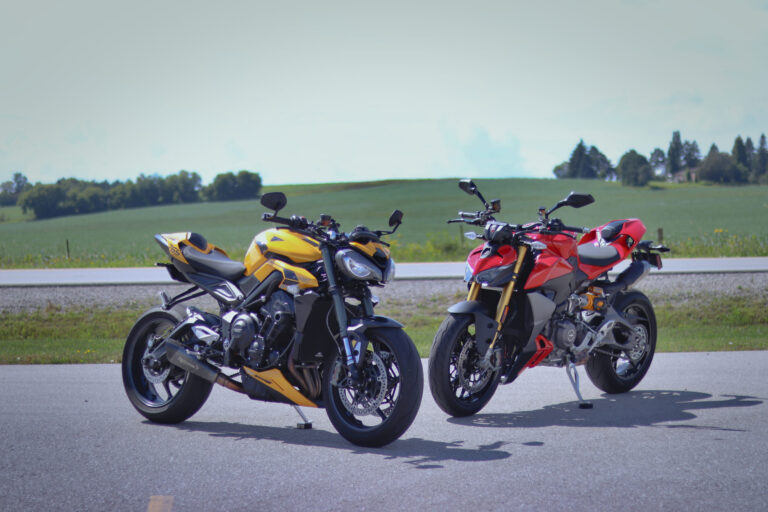
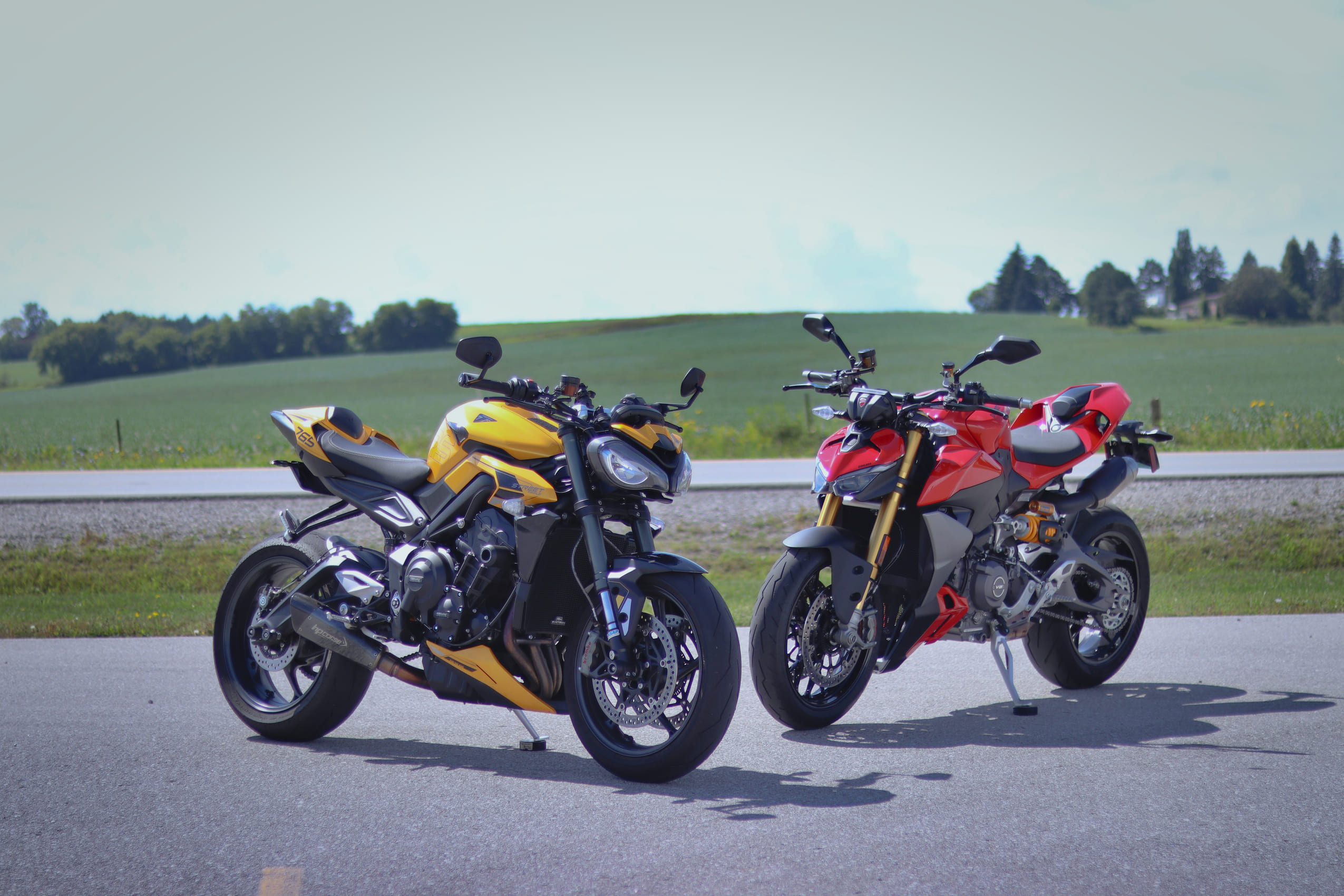
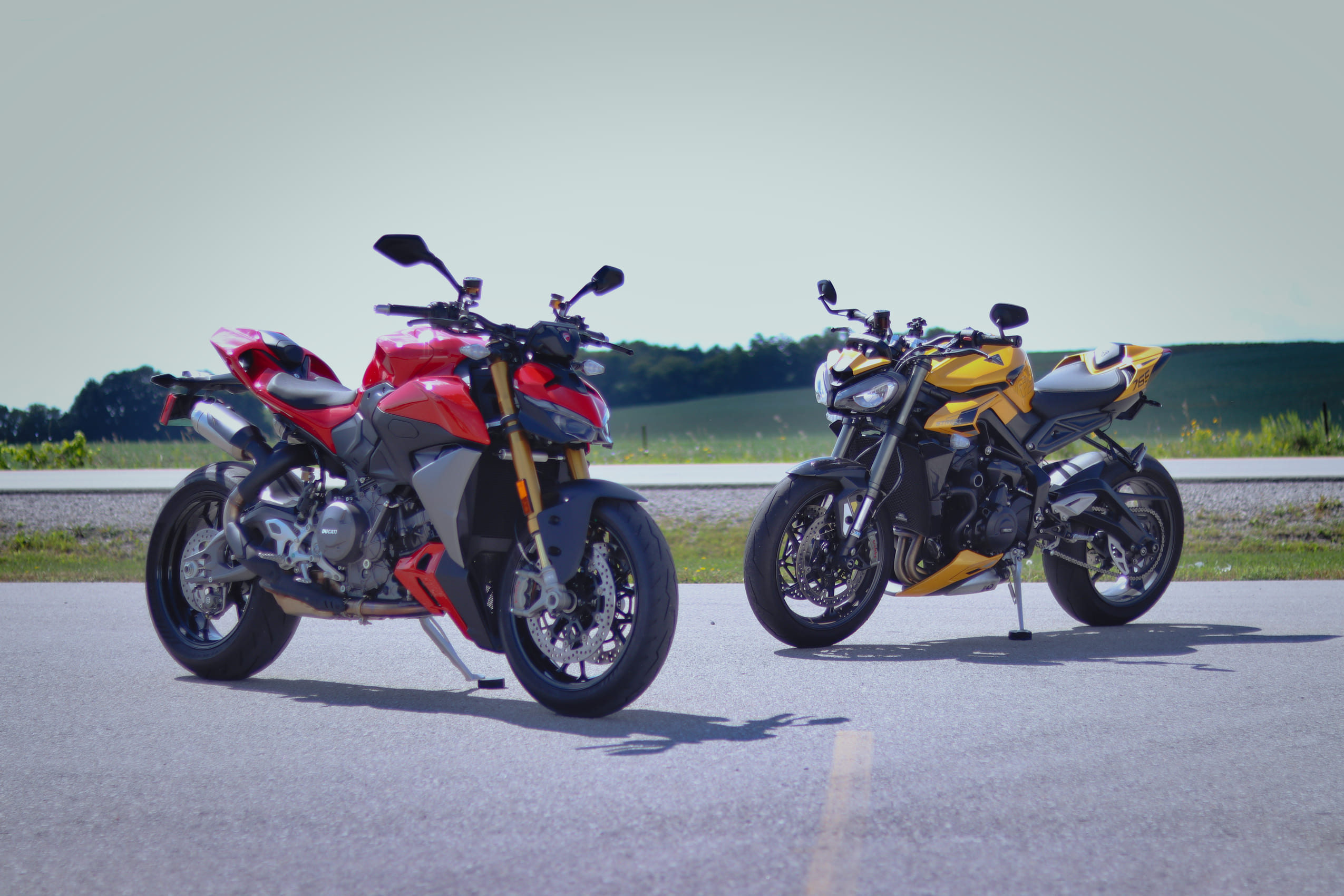
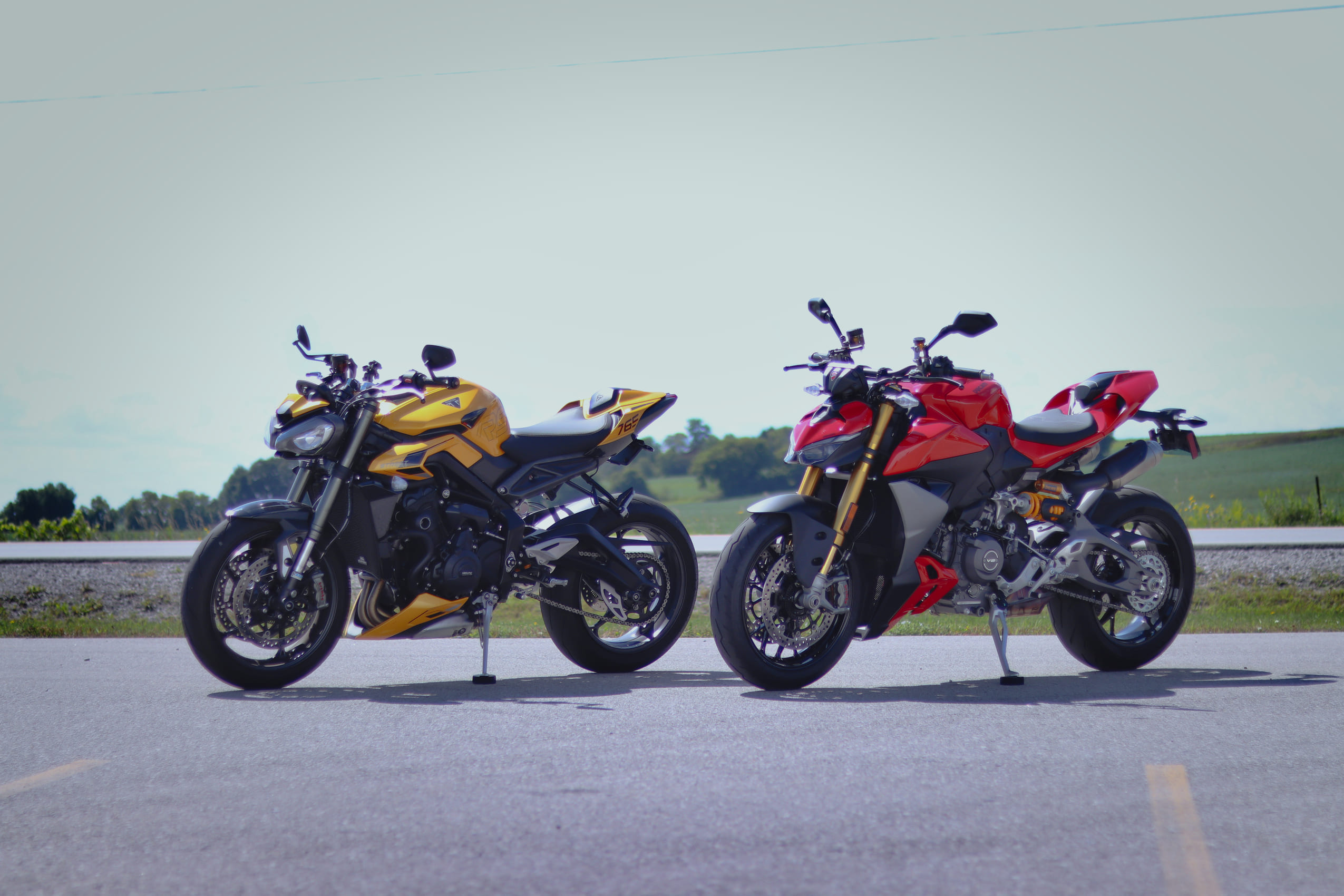
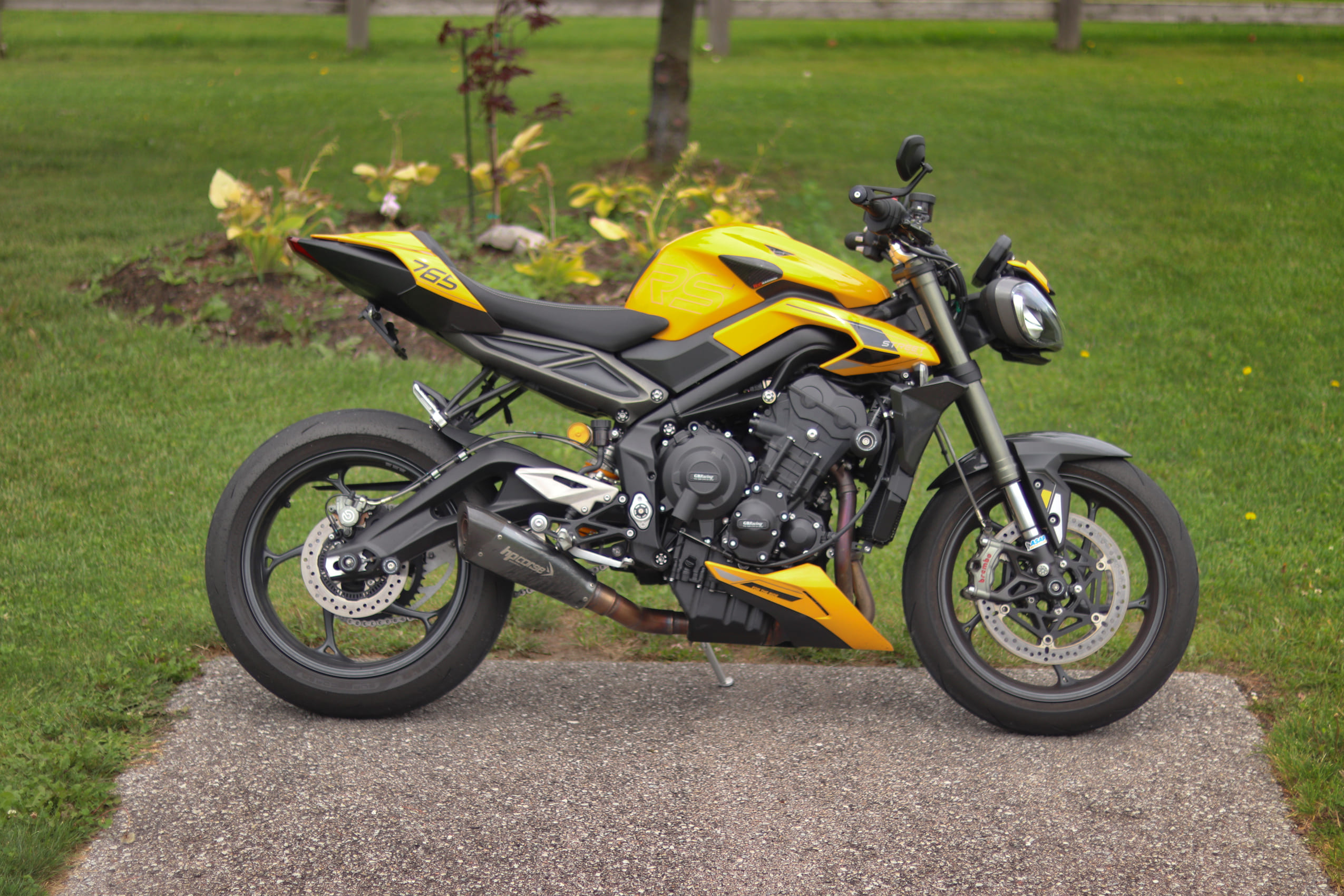
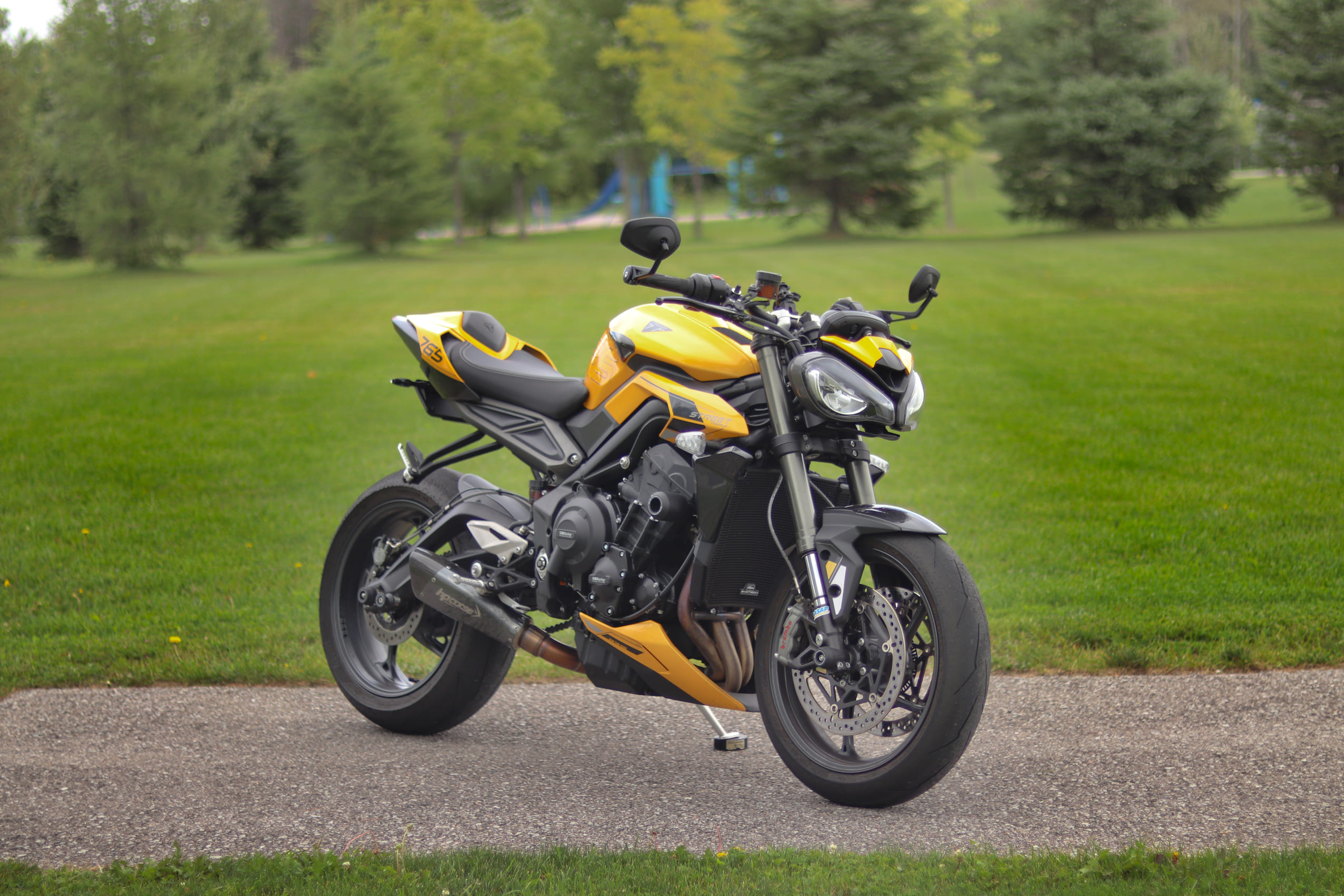
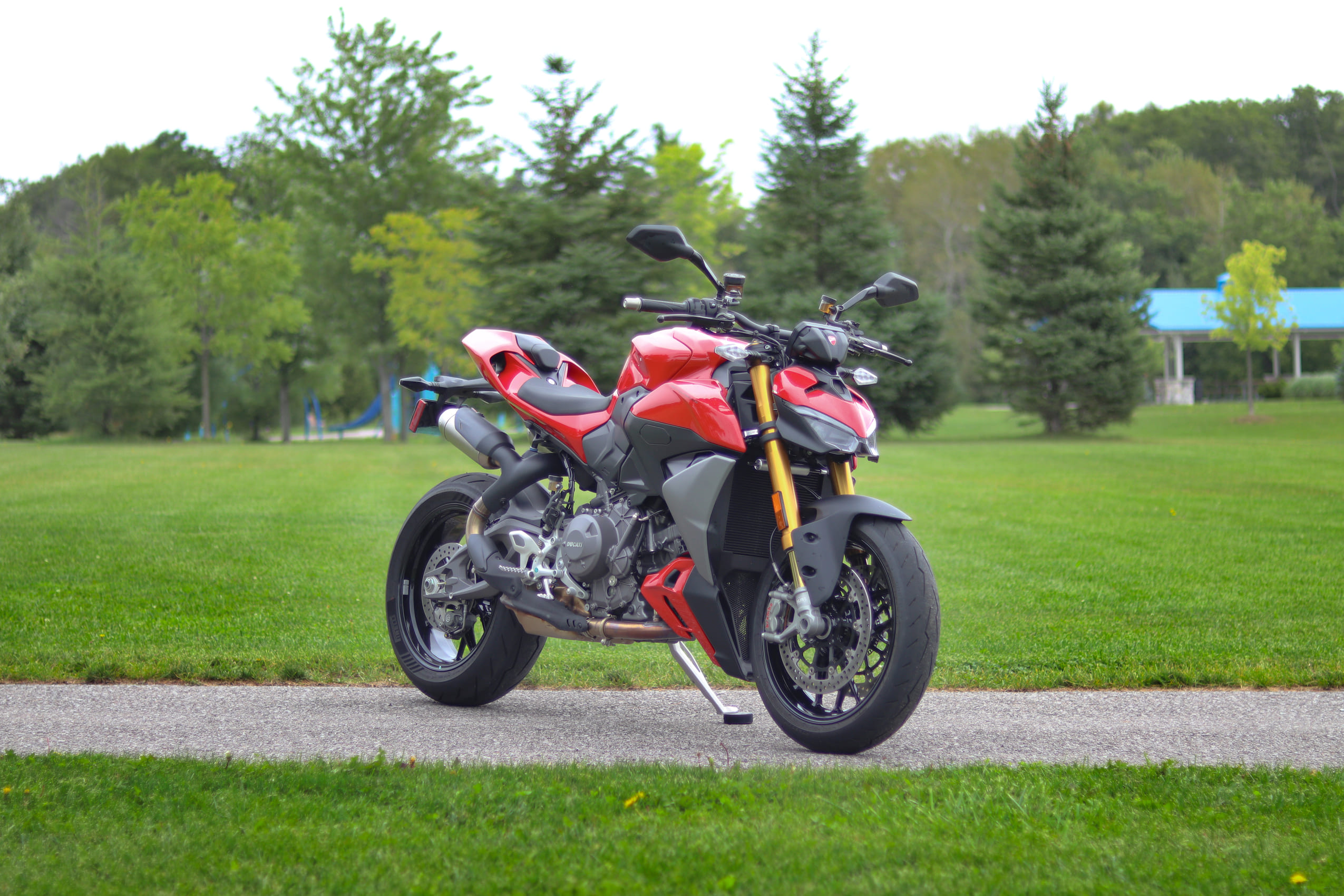
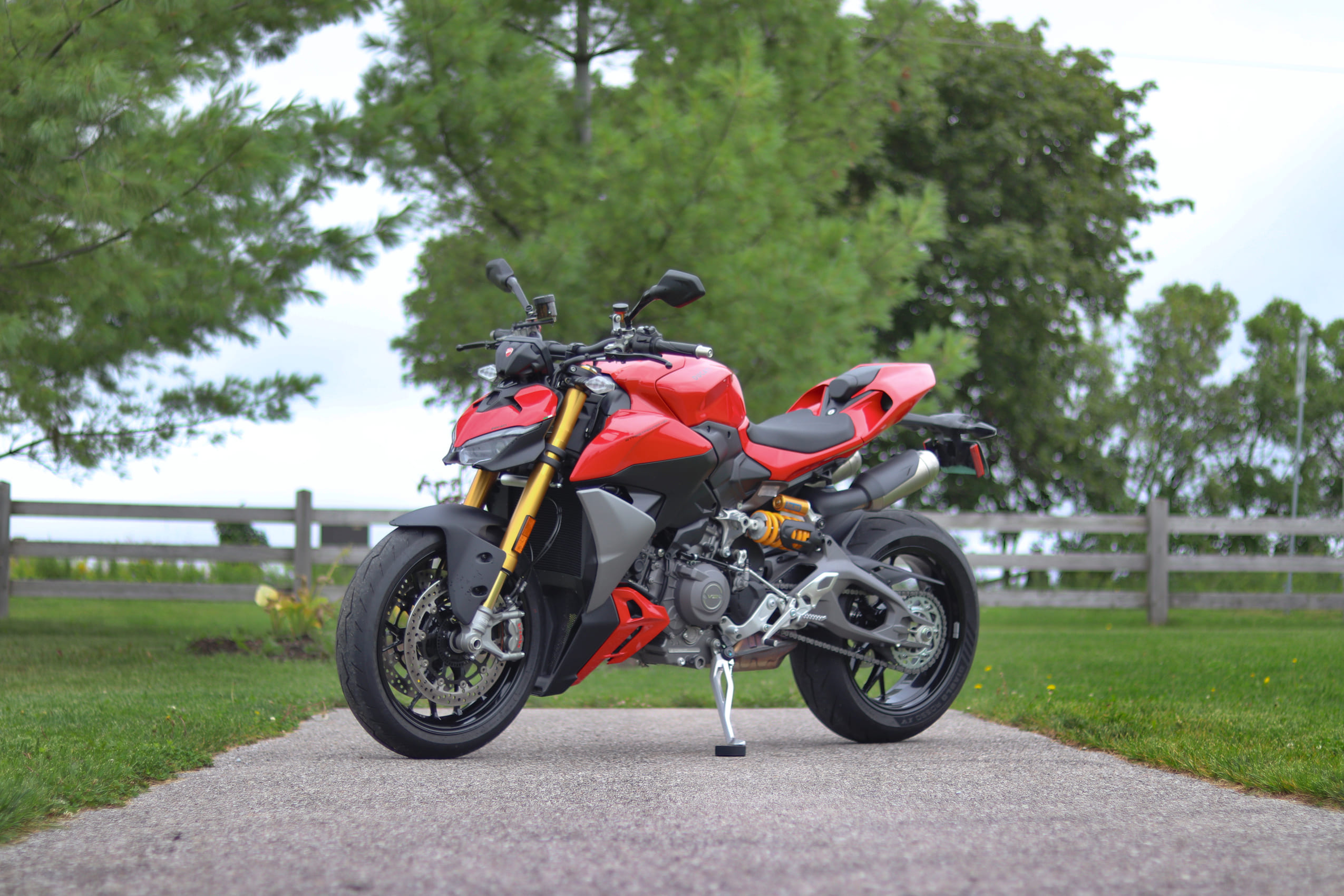
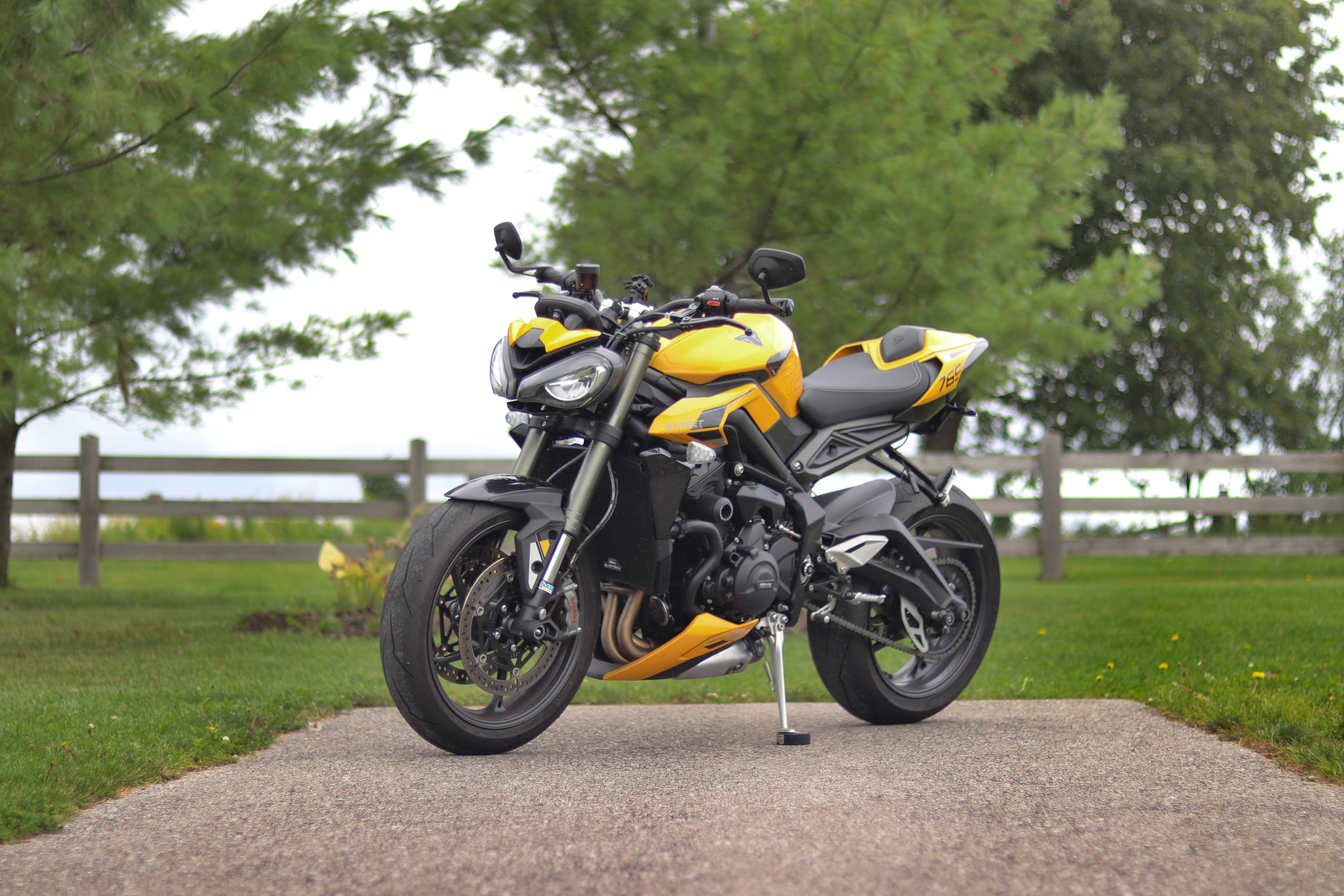
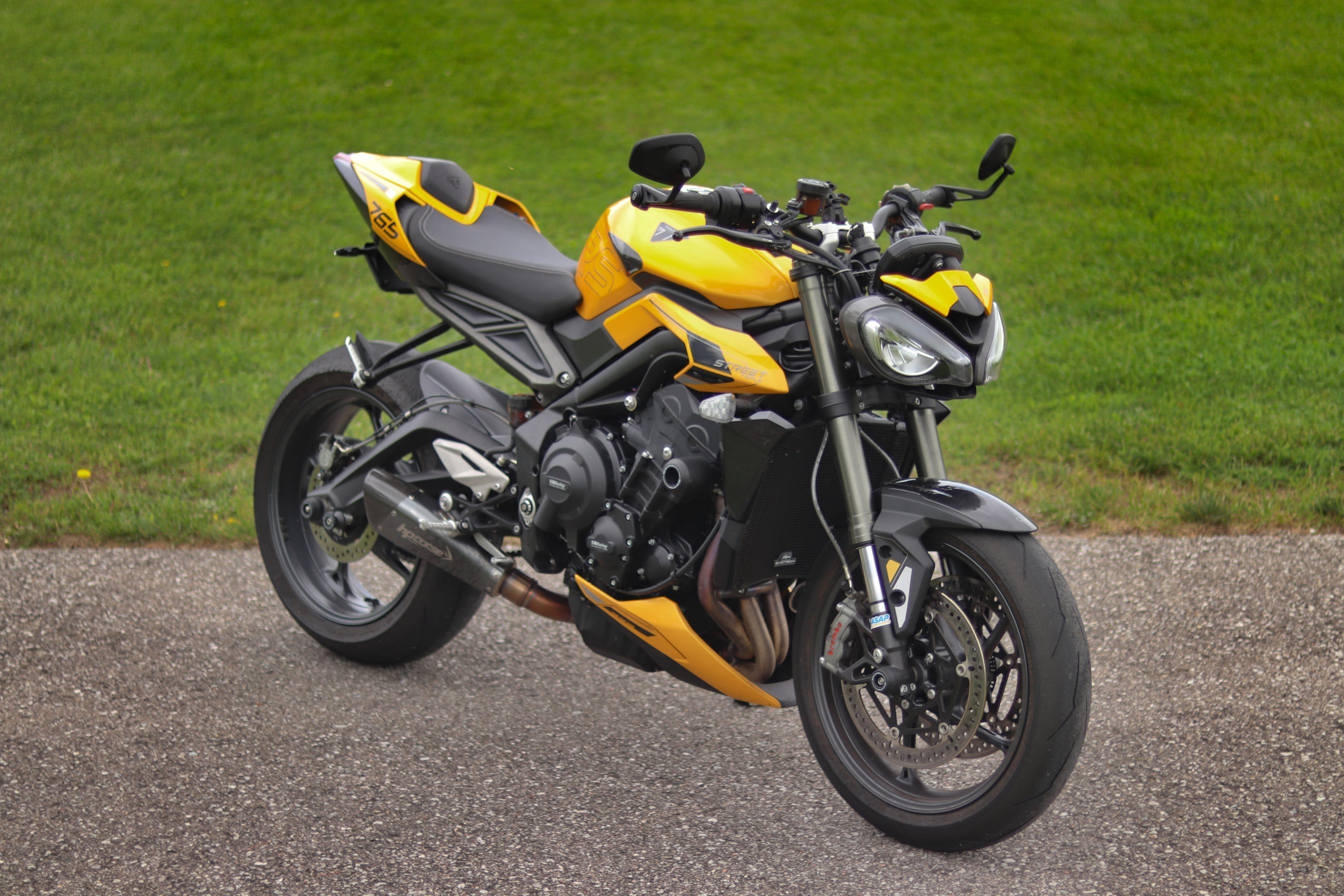
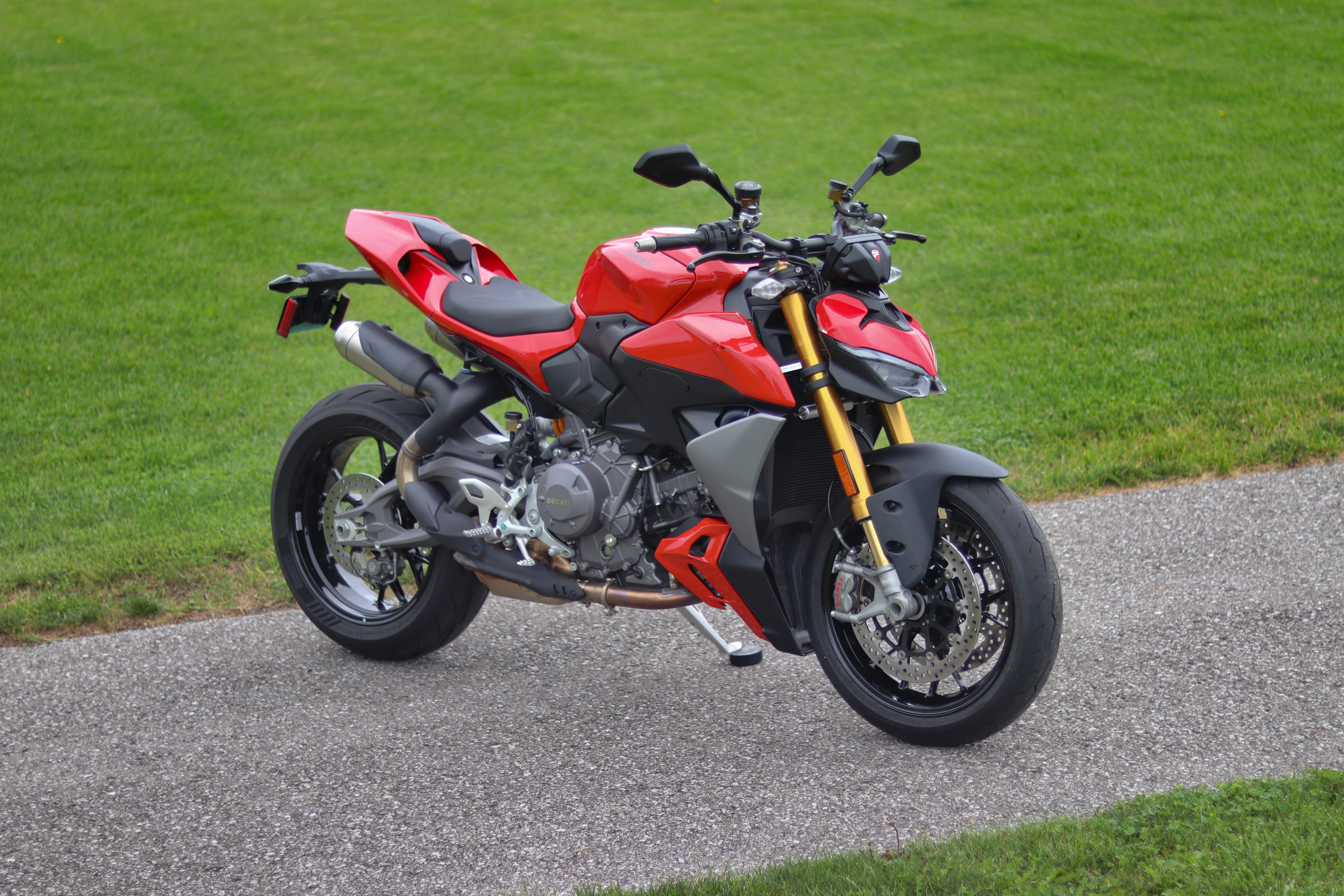
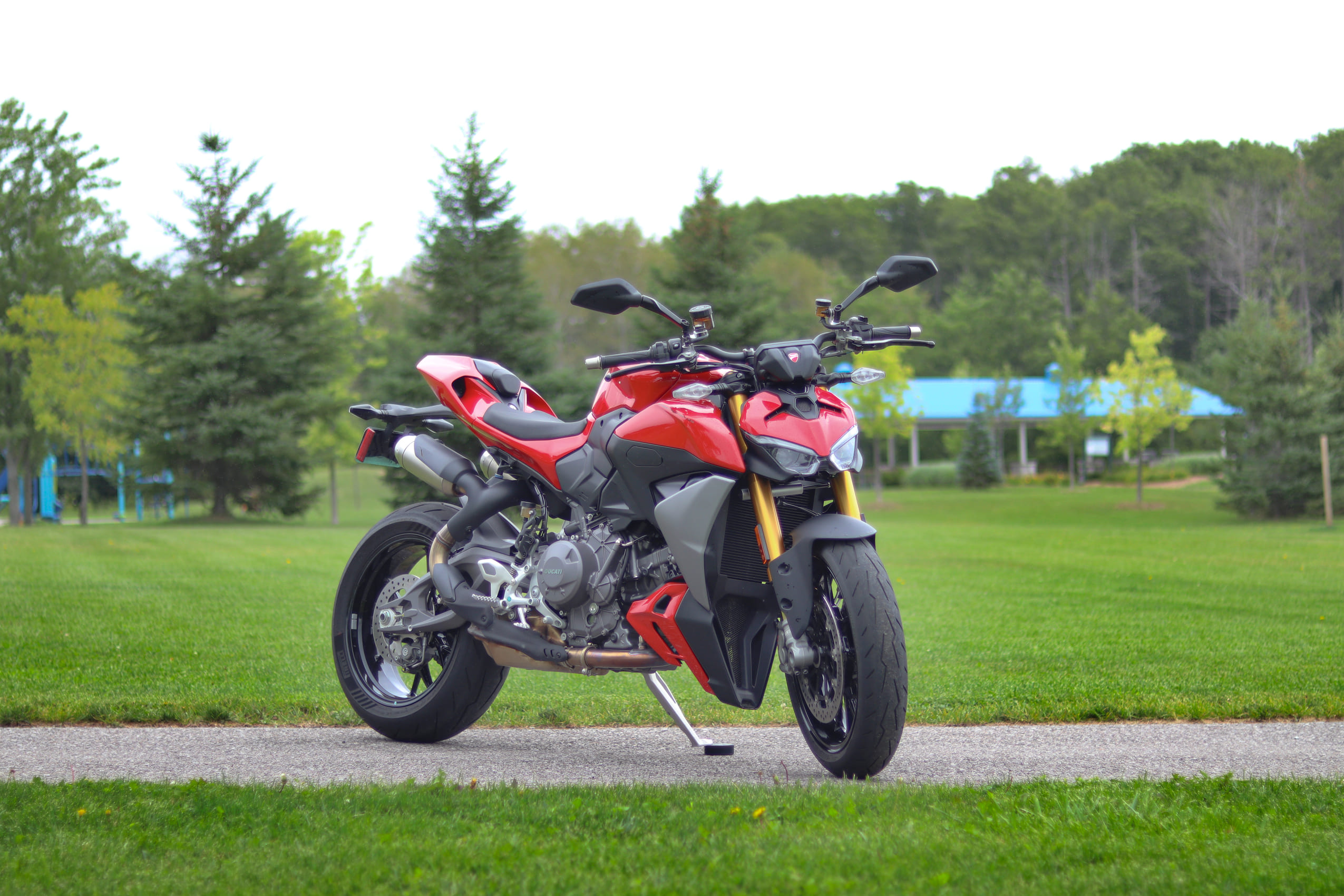
Park these two side-by-side in a sunlit paddock, and you are immediately treated to a masterclass in contrasting visual philosophies—or, more accurately, two entirely different ways to scream for attention.
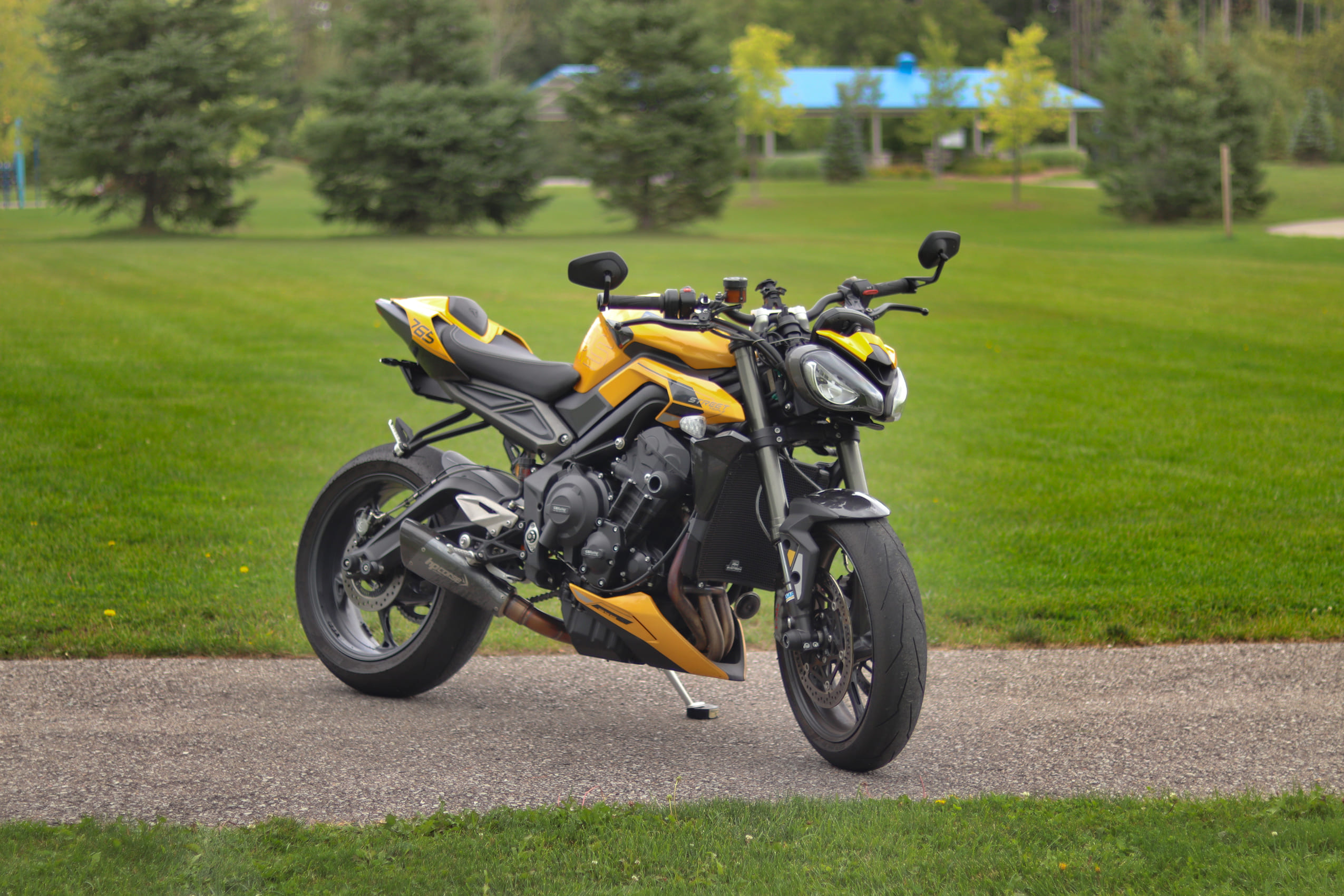
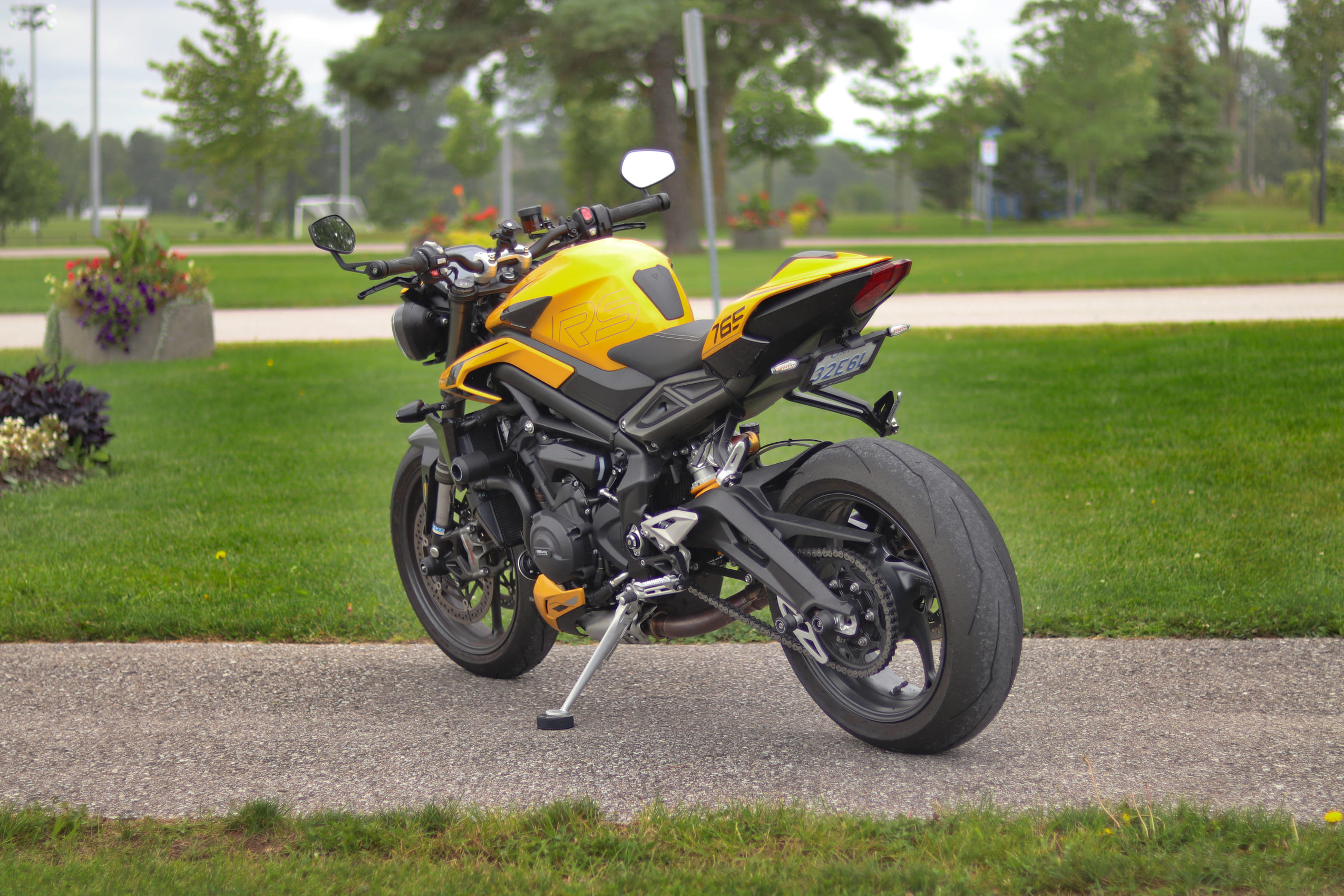
The Triumph arrives wrapped in a brilliant, sun-blasting yellow that feels less like a paint color and more like a high-octane hazard warning. Despite carrying over essentially unchanged since its 2023 visual sharpen, its taut, shrink-wrapped silhouette still looks wicked, defined by those unmistakable twin LED bug-eyes that grin at you like a mischievous wasp ready to sting your apexes. Every bracket, casting, and weld looks like it was designed by an obsessive engineer who’s deeply offended by unnecessary mass.
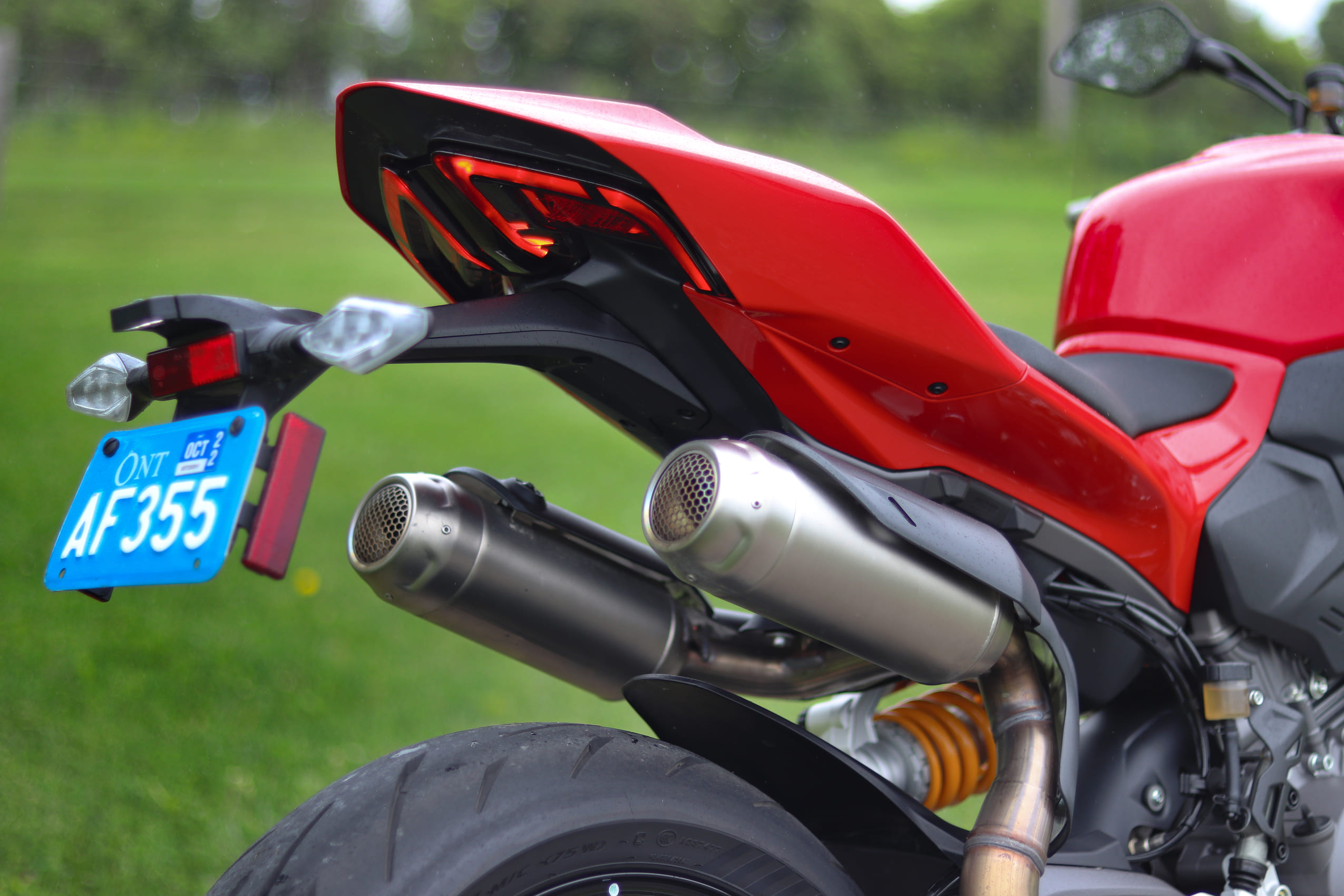
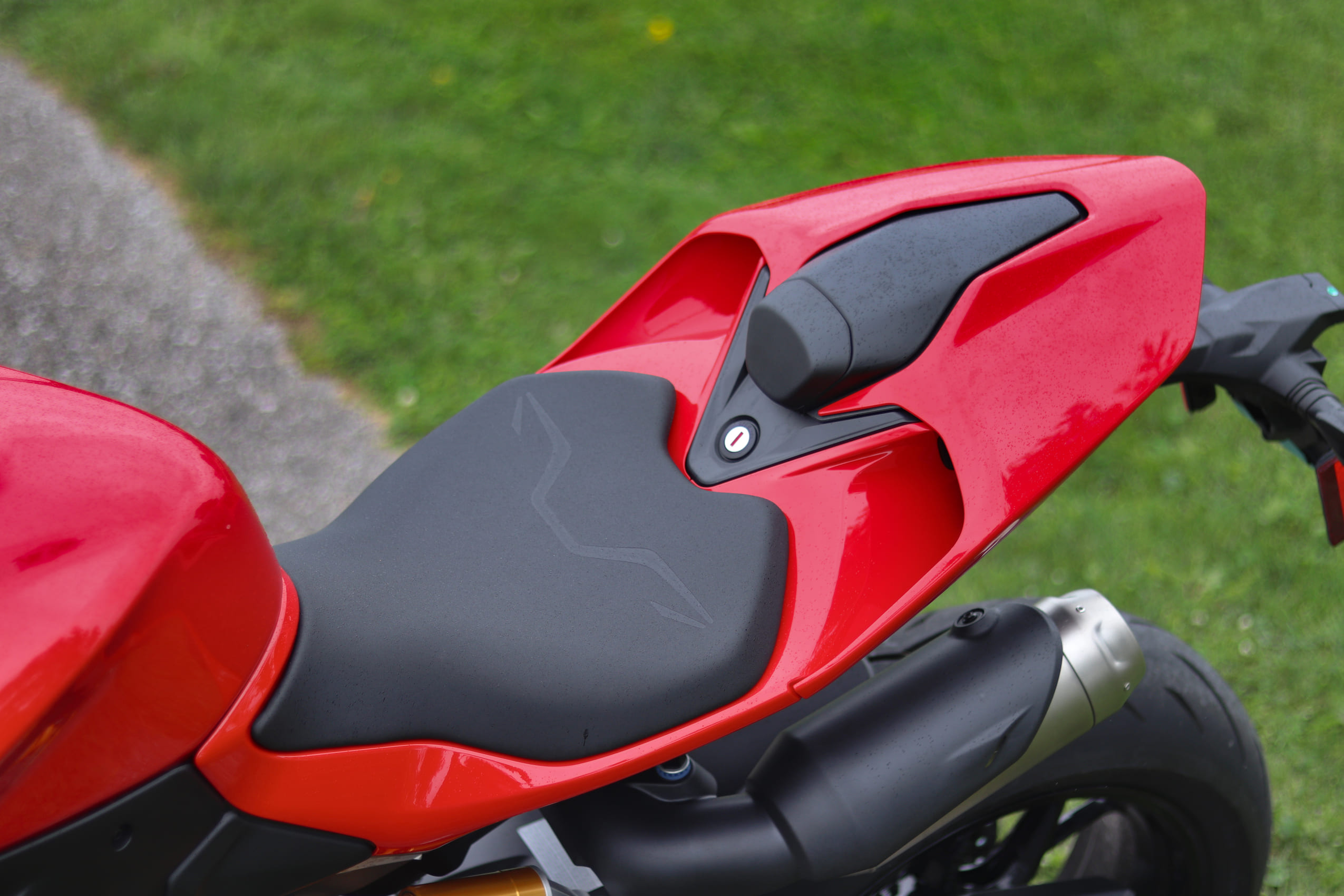
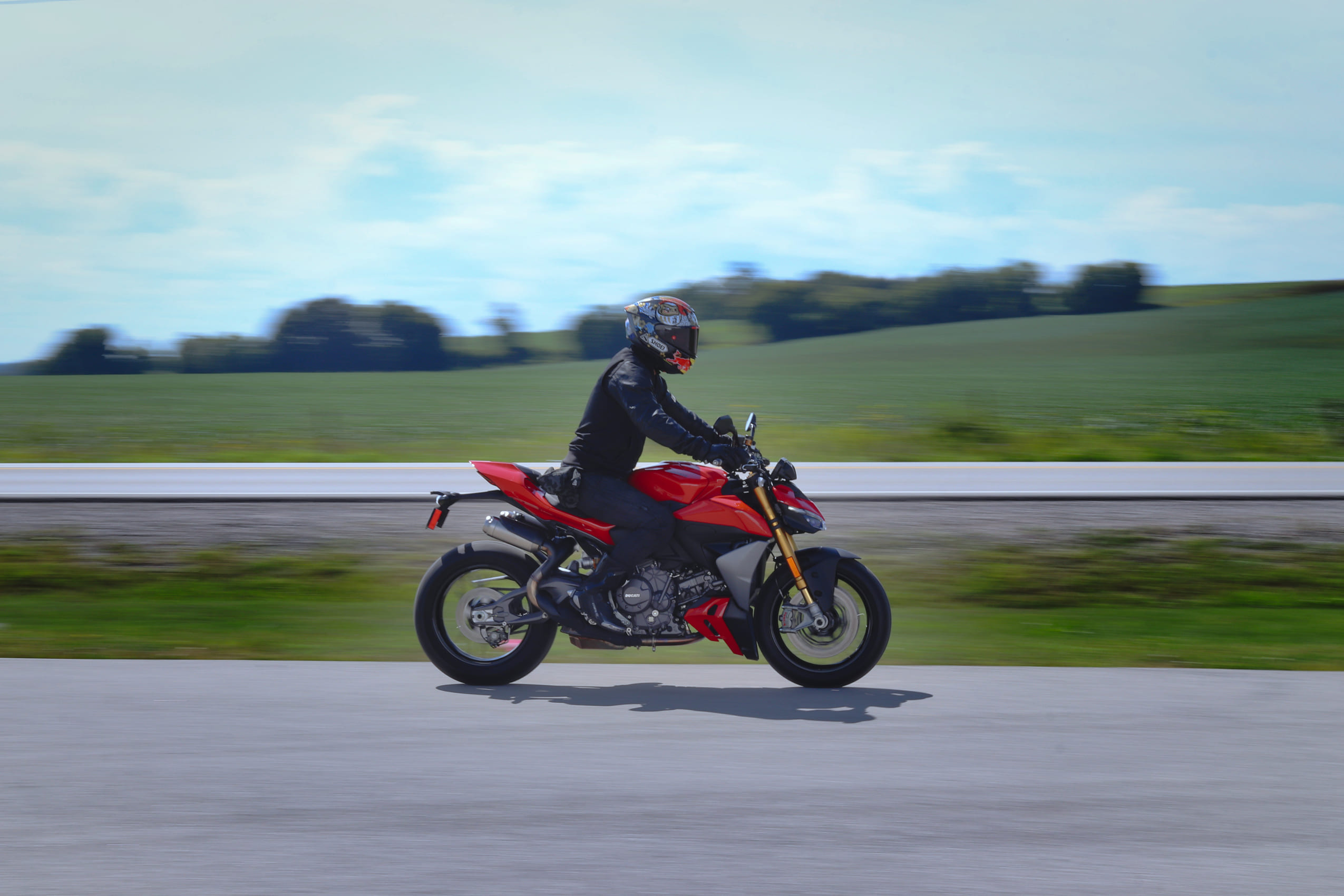
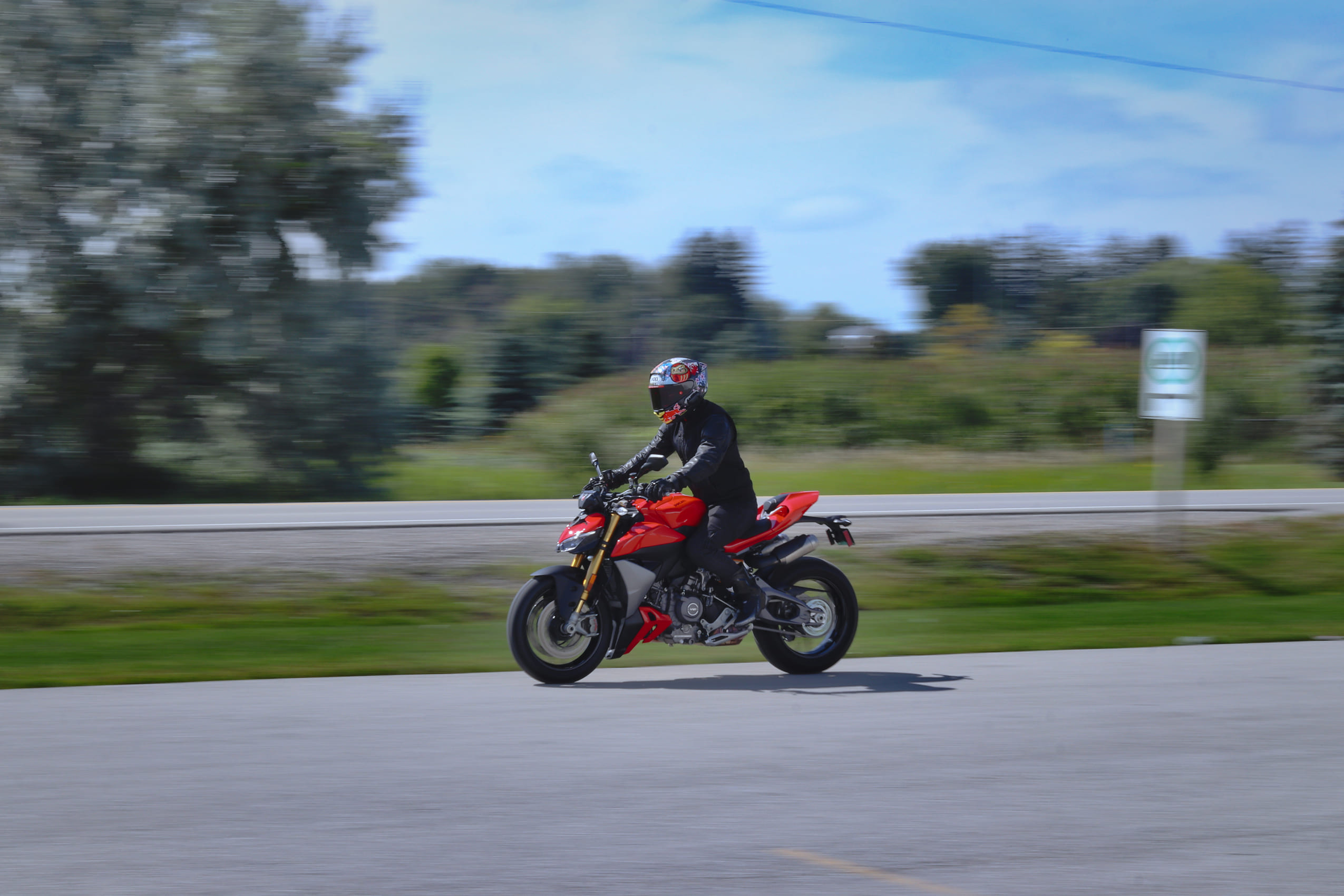
Then you turn around and face the redesigned Ducati, which is, naturally, drowning in a coat of Italian Red so deep and unapologetic, it practically commands you to pull out a checkbook. Where the older Streetfighter was a muscular brute, this overhauled model sheds its heavy visual bulk for a leaner, sharper, monocoque-framed chassis that looks like a naked superbike stripped of its skin. It’s all aggressive, forward-leaning angles and a razor-sharp front mask that looks less like a middleweight naked and more like a disgruntled Decepticon designed to intimidate innocent commuters at gas stations. The Triumph looks like a familiar track weapon refined to slice up lap times; the new Ducati looks like a freshly forged piece of Italian exotica sculpted to sit outside a Milanese café and look impossibly expensive while quietly smoldering.
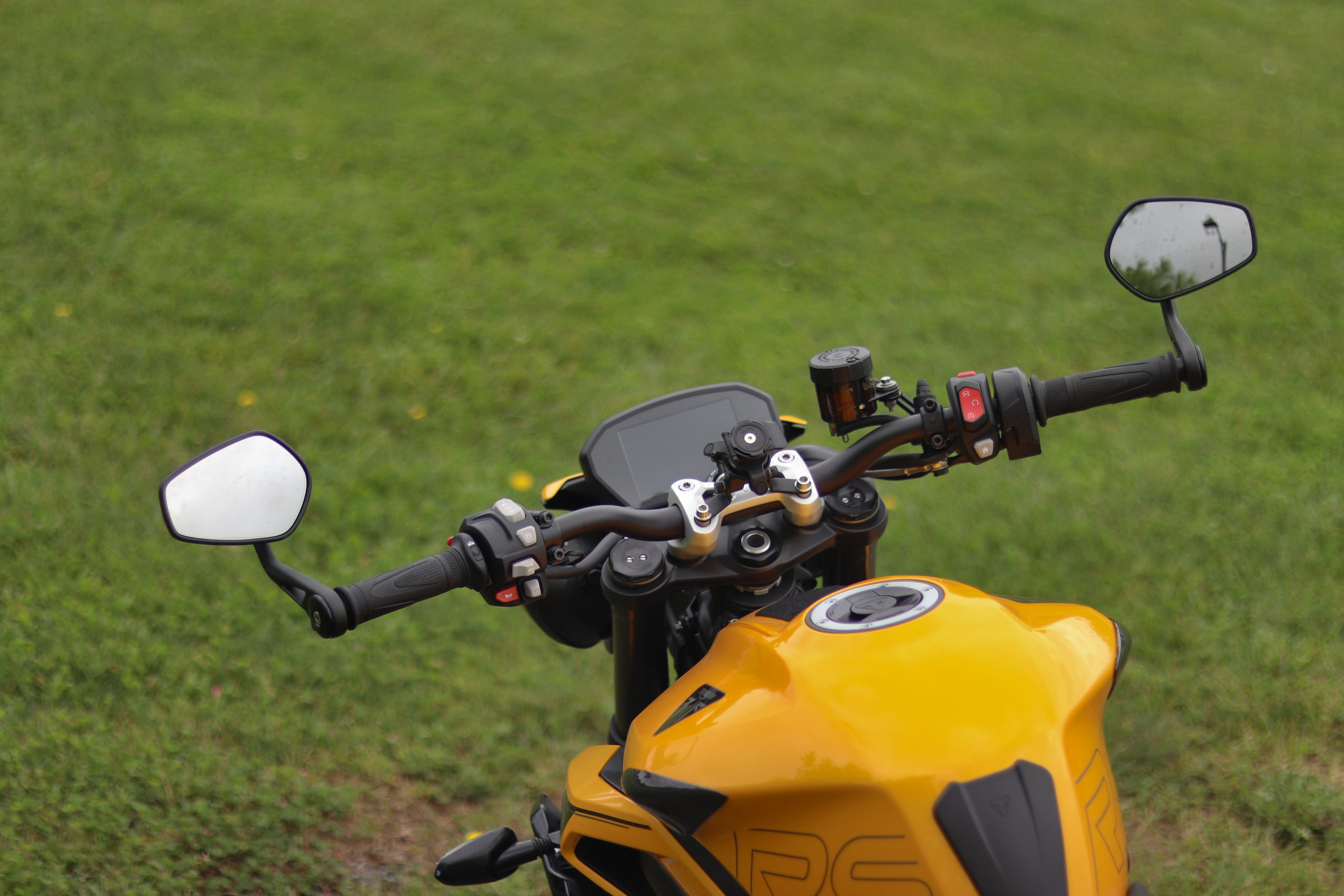
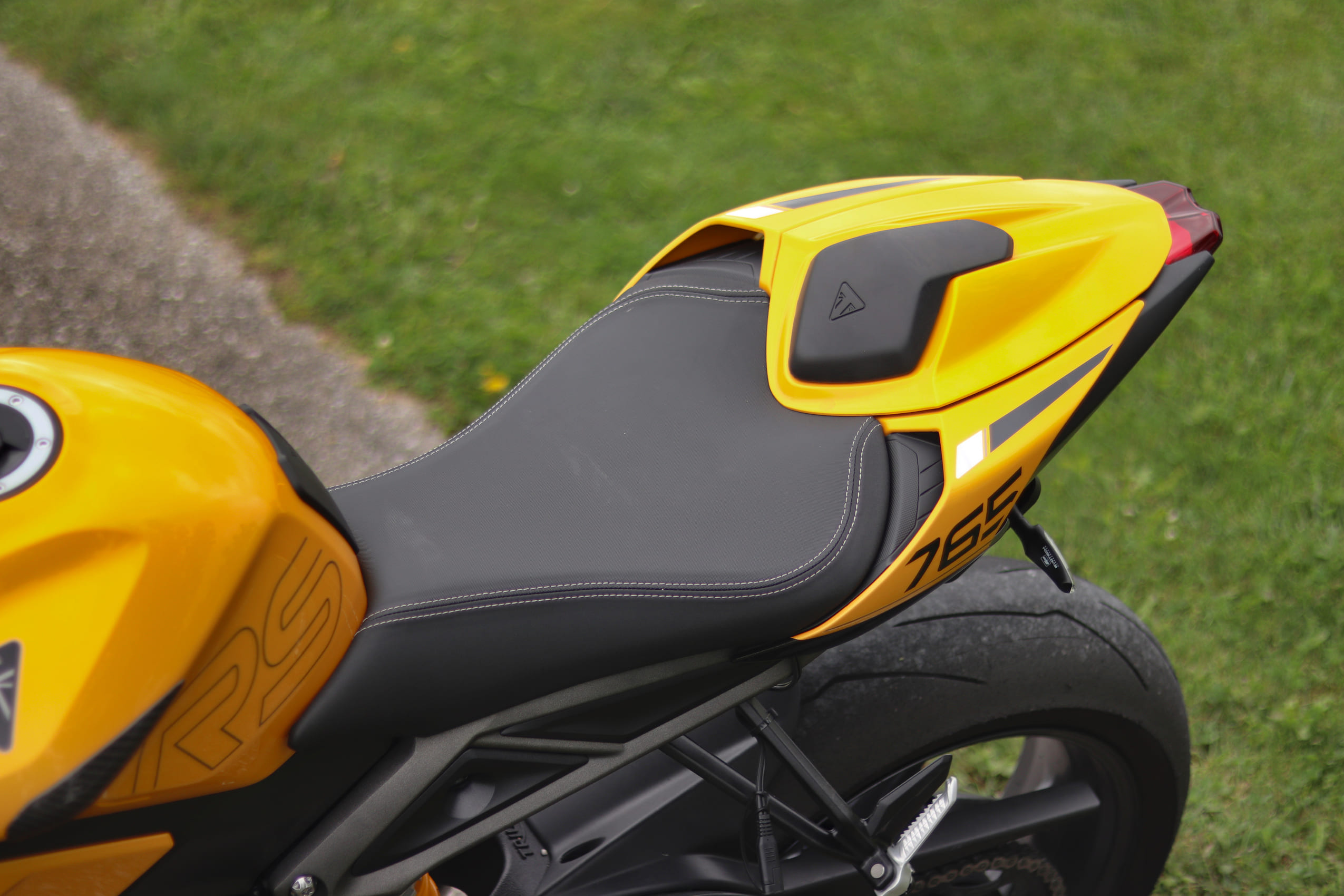
Throw a leg over the Triumph, and it greets you with surprising, almost disarming hospitality. The seat is broad, properly cushioned, and shaped as if someone at Hinckley actually remembered human buttocks are made of living tissue rather than carved mahogany. The handlebar reaches back to meet your hands, tucking your torso into a position that is comfortably upright without feeling lazy—a geometry relaxed enough to let you commute all week without booking an emergency chiropractic adjustment, yet precise enough to keep your front tire glued to the tarmac when the pace turns frantic.
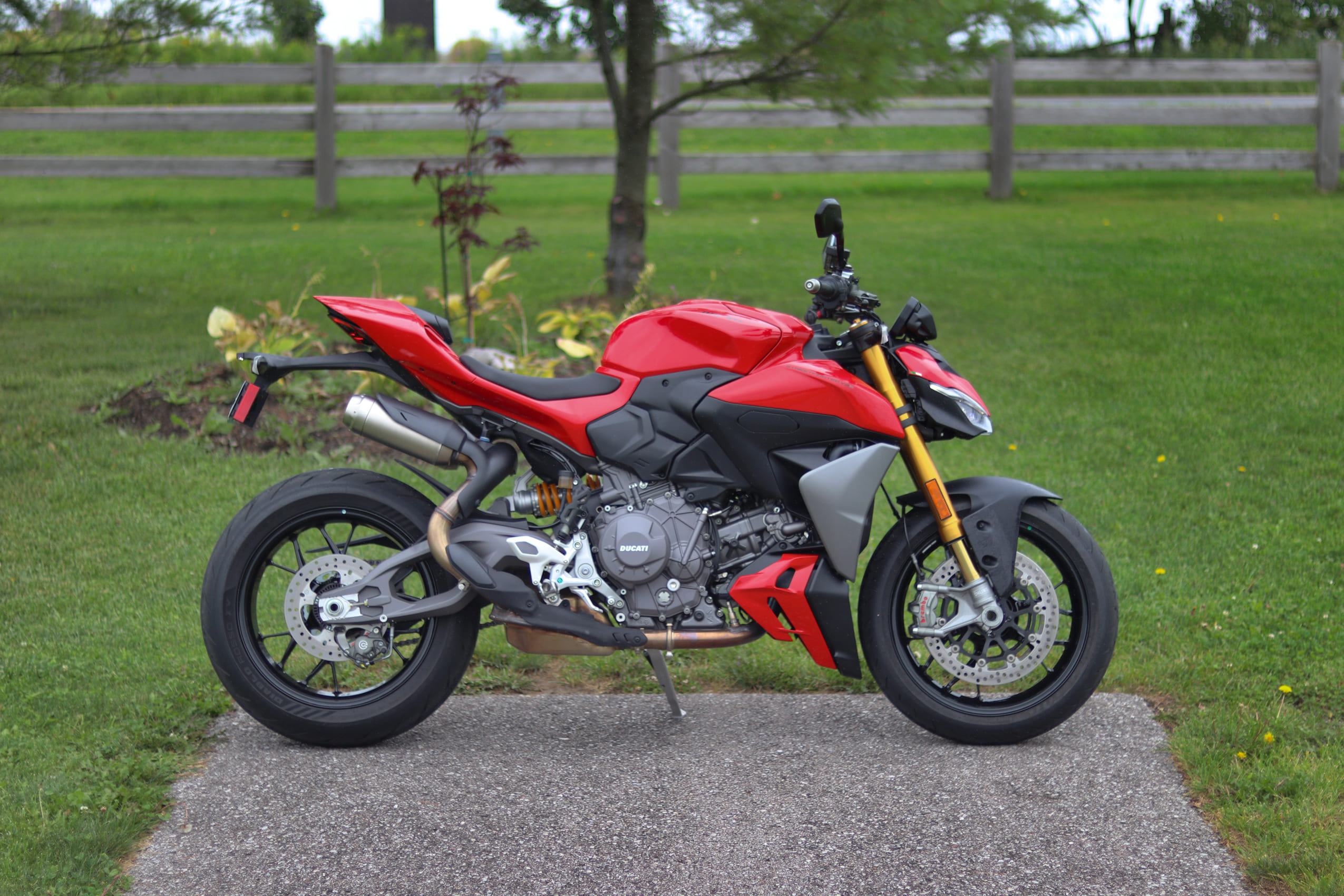
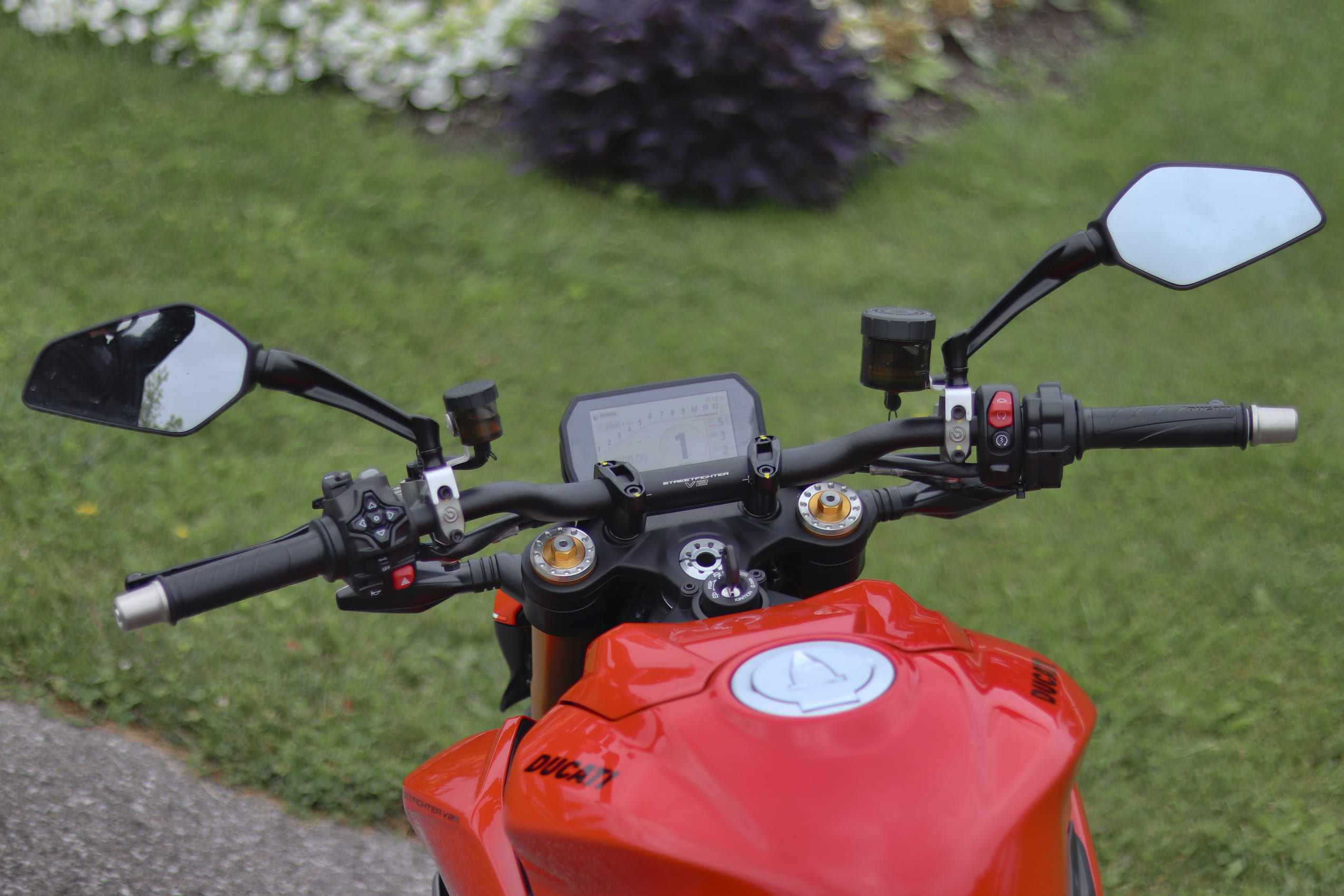
Step onto the Ducati, however, and all pretense of practical everyday comfort vanishes into the ether. This is not a relaxed commuter; this is a full-throttle assault on your lower lumbar. The Streetfighter forces you forward over the tank, stretching your torso out toward a low, wide bar in a posture so aggressively pitched over the front wheel it feels like you’re doing a perpetual push-up over the triple clamp. The saddle is firm, uncompromising, and clearly designed around the assumption that you’ll be hanging off the side of it at track speeds rather than sitting in gridlock. The Triumph lets you ease into the ride; the Ducati demands you sign a physical contract before you even thumb the starter.
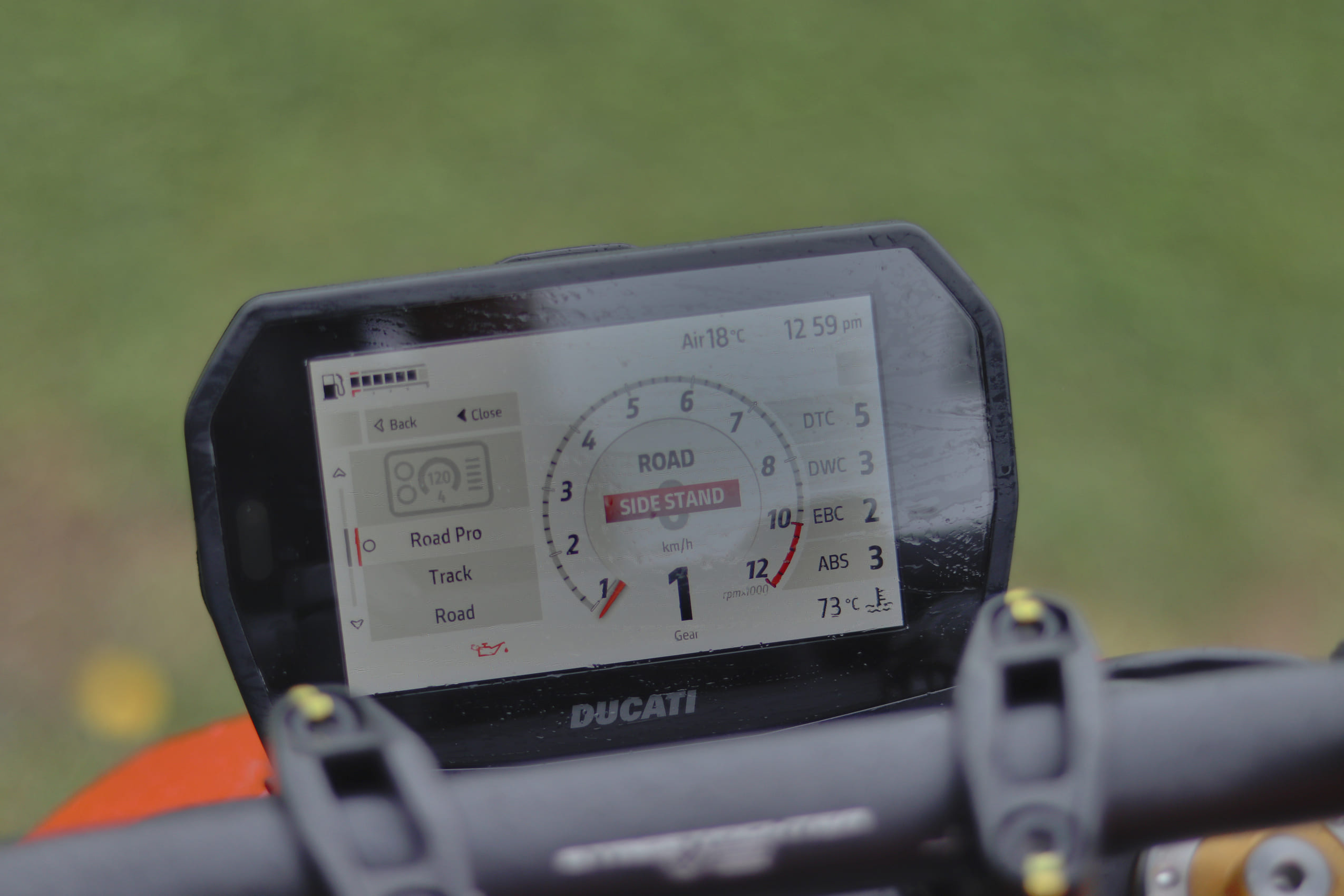
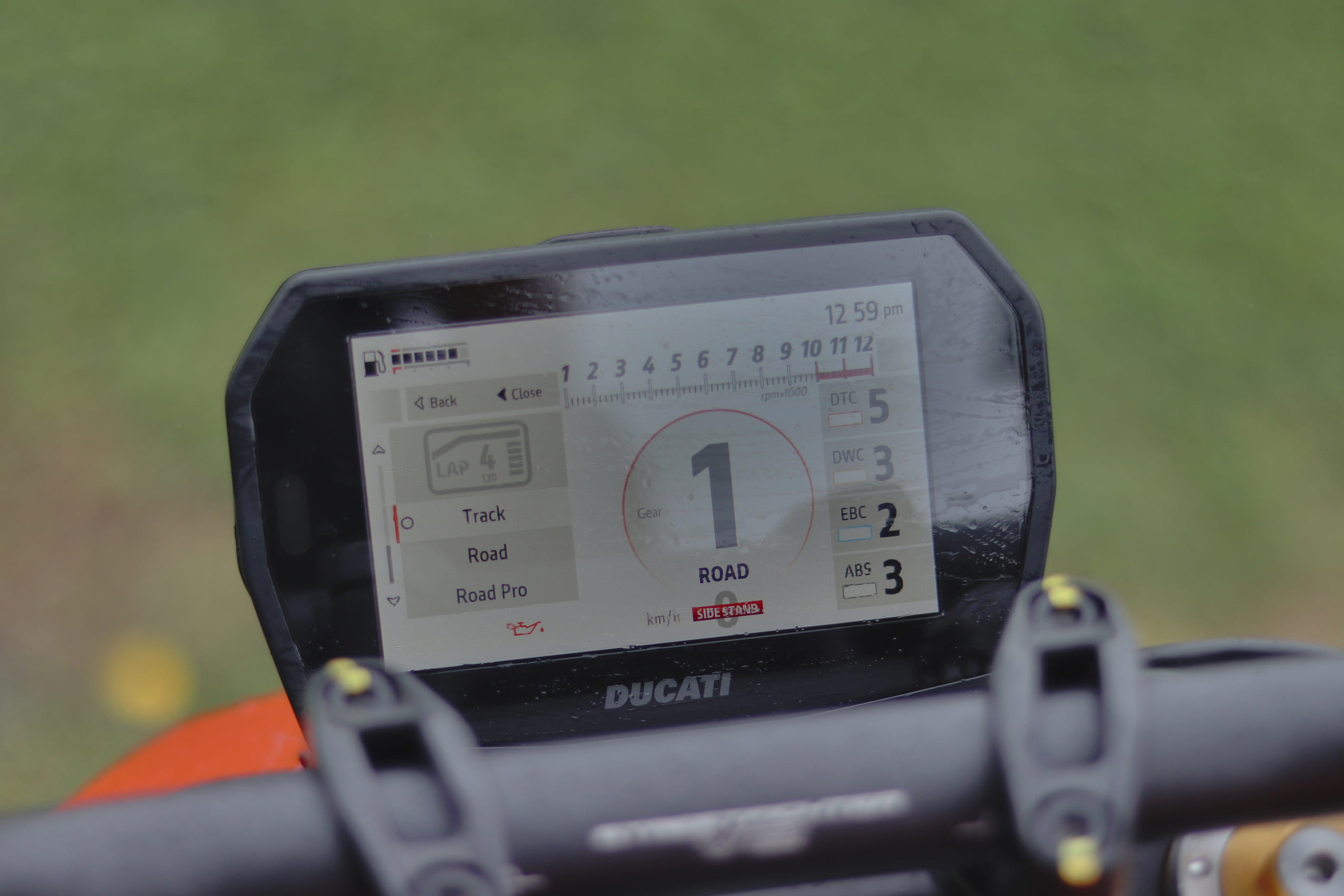
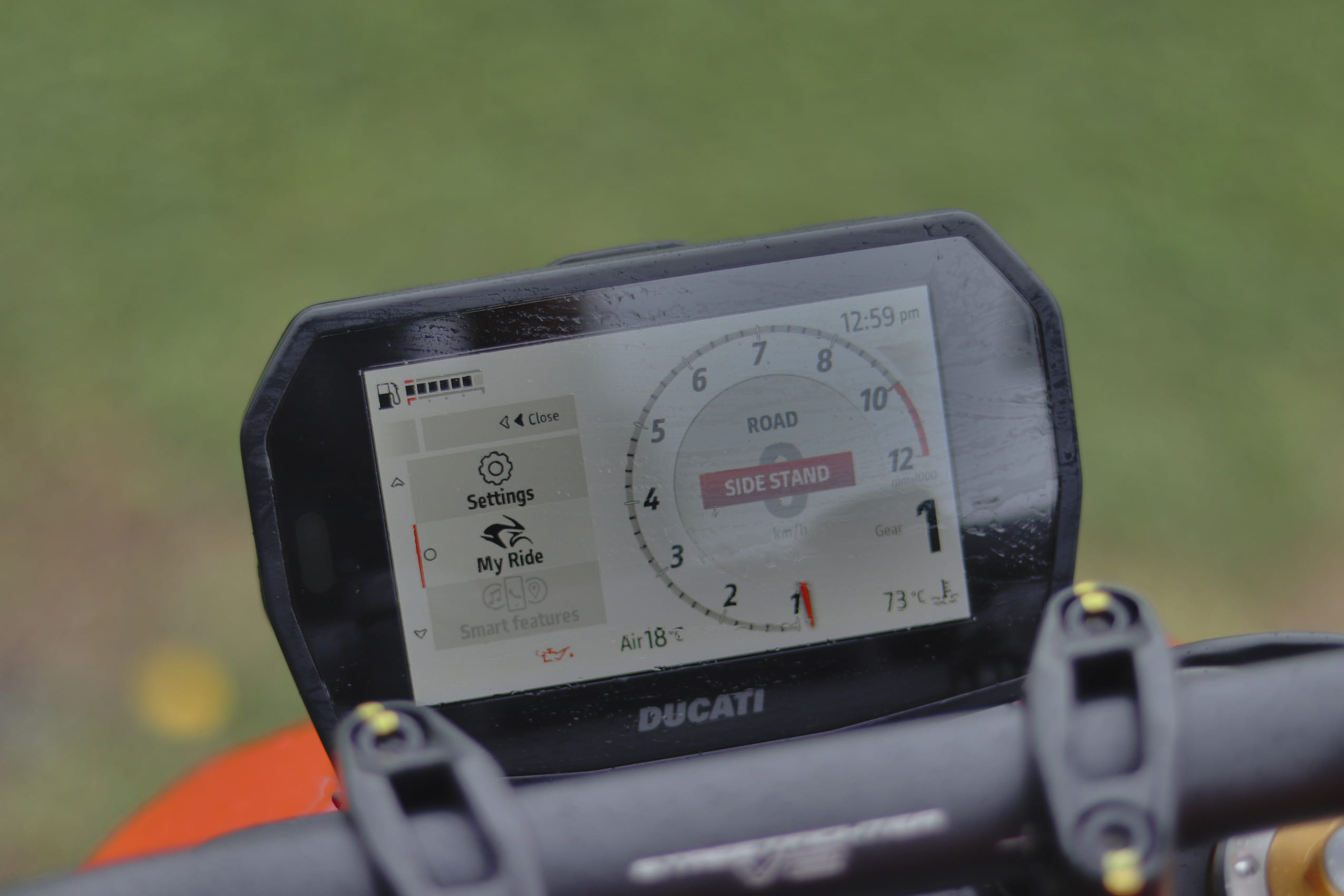
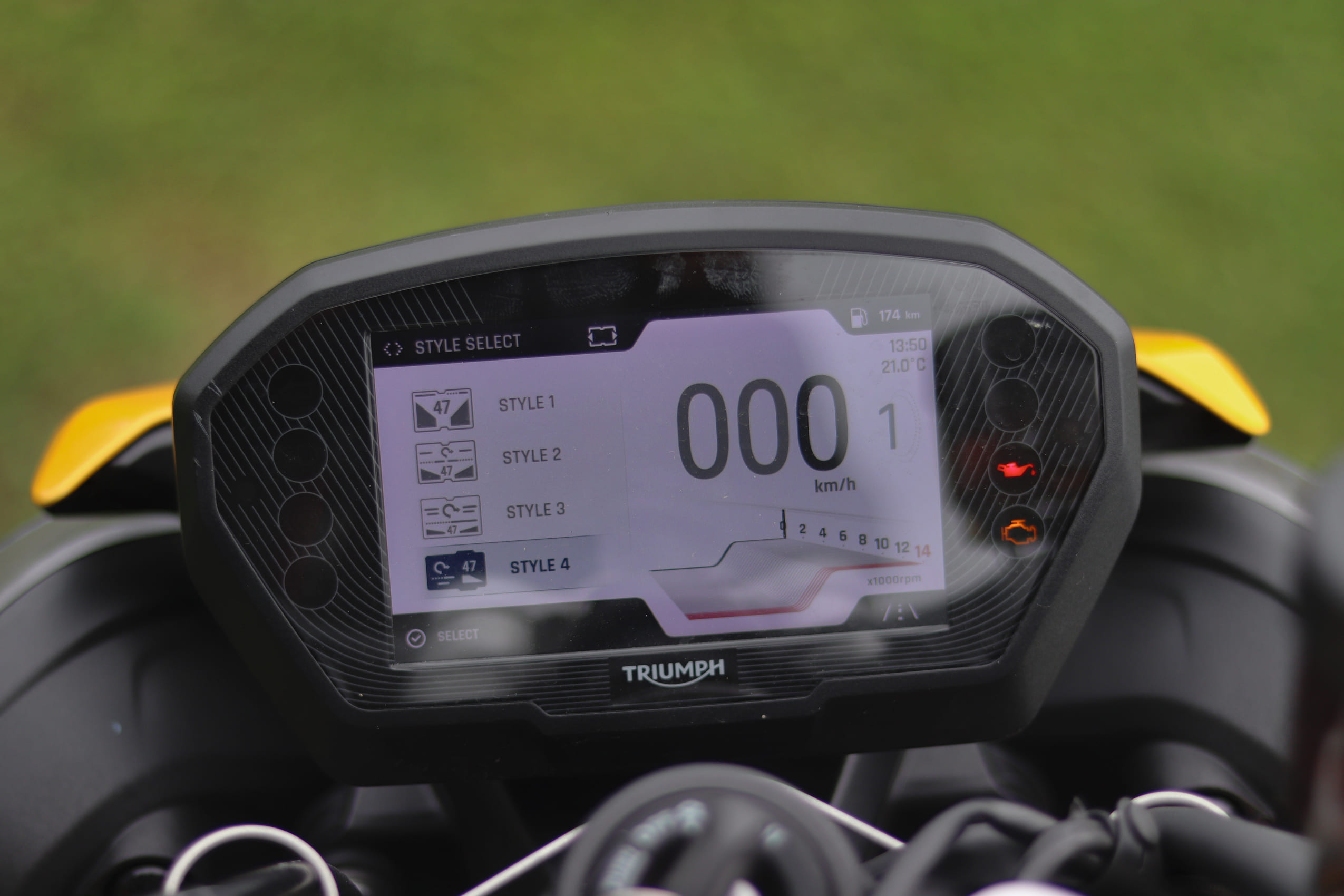
And then we come to the digital nerve centers, where the gap between these two transitions from a subtle contrast in design into an absolute bloodbath.
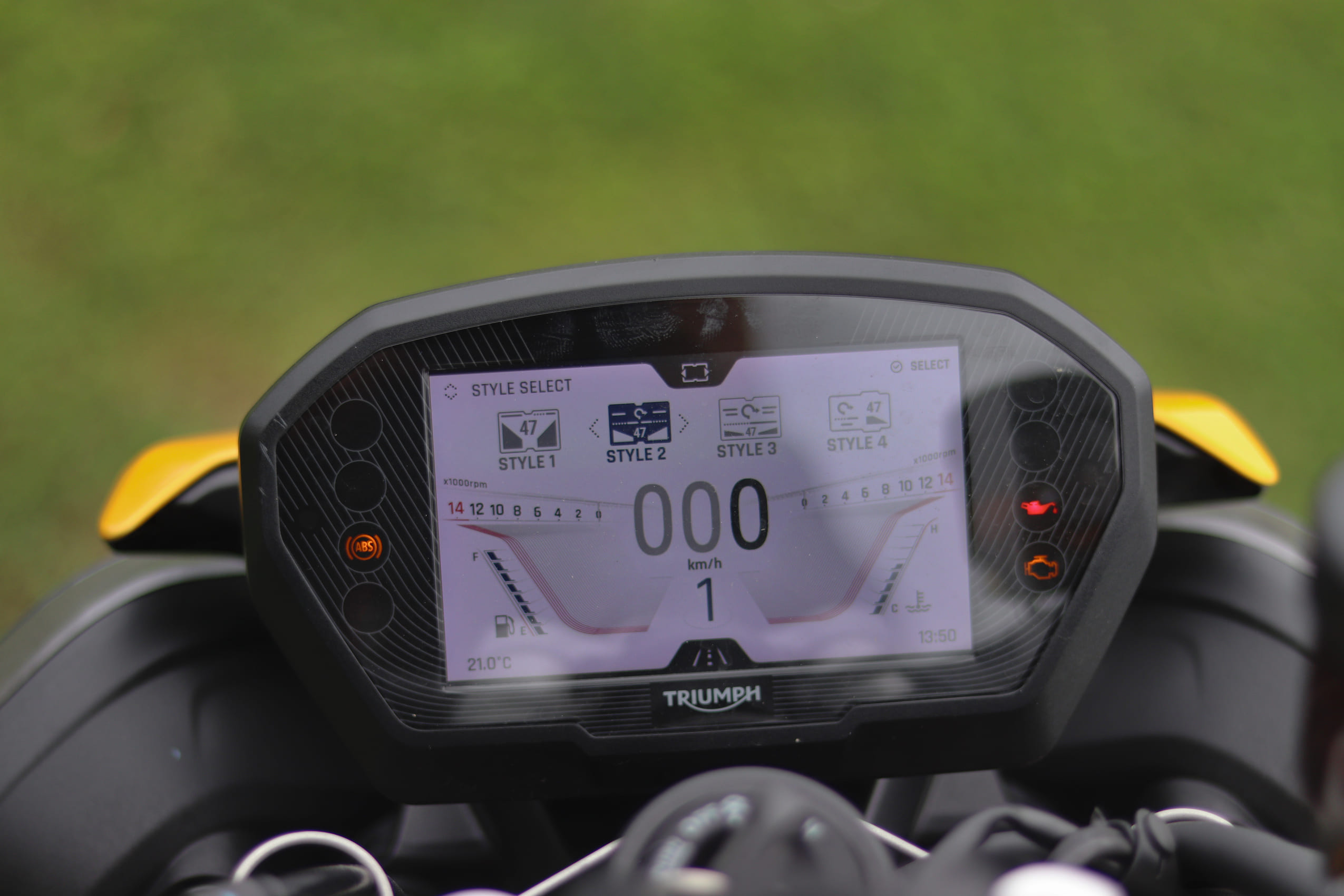
If you glance down at the Triumph, you’re greeted by a dashboard layout that feels like it was coded during the Obama administration and never quite updated. Yes, it offers different graphic themes, but they range from “fussy and over-designed” to “actively unreadable while moving.” Trying to parse your engine speed or gear position at a rapid clip requires a level of squinting concentration that usually leads to missing your braking marker entirely. It’s an exercise in visual clutter—a tiny, outdated glass rectangle trying to convey too much information through bizarre, abstract layout choices that make no sense when you’re actually riding fast.
The Ducati, meanwhile, simply steps up and obliterates it. Borrowing heavily from the ultra-slick, modern interface architecture of Borgo Panigale’s flagship superbikes, its display is crisp, ultra-vivid, and intuitively laid out. The graphics are rendered with high-definition clarity that makes the Triumph look like a hand-held electronic game from the nineties, giving you bold, unmistakable readouts for revs, lean angles, and rider modes that hit your retina instantly. It gives you precisely what you need, exactly when you need it, with the polished, premium feel of an iPad Pro—leaving the Triumph’s screen looking less like a modern instrument cluster and more like an embarrassing relic of a bygone digital era.
The Ducati’s newly minted 890cc V2 engine is a complete revelation, ditching the peaky, low-rpm fueling temper tantrums of its predecessor in favor of something genuinely astonishing: civil behavior. Down low, where older Italian twins used to buck and shudder like a trapped wild animal, this new 120-horsepower motor purrs through city traffic with fluid, effortlessly easy modulation. But wring its neck toward its 10,750 RPM ceiling, and its intake variable valve timing kicks open to hit you with a thick, gorgeous 69 lb-ft wave of midrange torque—all pushing a featherweight 386-pound dry weight that turns every twist of the throttle into a minor event.
The Triumph’s iconic 765cc triple, on the other hand, operates on a totally different wavelength of thrill. Delivering a punchier 128 horsepower alongside 59 lb-ft of torque, it is undeniably smoother, spinning up to a soaring, howling 12,000 RPM redline with the hyperactive eagerness of a mechanical sewing machine on caffeine. It is an absolute masterclass in linear power delivery, but Hinckley’s engineers made a very specific choice with its aggressive, race-derived short gearing—and you will feel it the exact second you hit an open interstate highway.
Cruising at speed leaves the motor sitting uncomfortably high in the rev range, buzzing through the handlebars and burning through fuel at a rate that makes your wallet weep. It isn’t any less fun than the Italian—it’s just a completely different flavor of joy. The Ducati is a punchy, muscle-flexing riot that begs you to squirt from corner to corner; the Triumph is an addictive, high-revving turbine that demands you keep the throttle pinned and sing for your supper. Speaking of cruising, both bikes offer cruise control as an option, Ducati is the one that pulls KTM moves with installing the hardware, but asking you to pay the software to activate it.
Shift your focus to the underpinnings, and you’ll find two very different philosophies on how to suspend a high-strung middleweight naked. Ducati went straight to the top shelf for the Streetfighter V2 S, bolting up full Öhlins hardware at both ends—a 43mm NIX30 fork up front mated to an Öhlins monoshock out back, clamped down by fierce Brembo M50 monobloc calipers. Triumph, on the other hand, plays a slightly trickier game of spec-sheet pick-and-choose. The Street Triple RS gets an Öhlins STX40 rear shock, but the factory holds back on matching golden forks, assigning that privilege exclusively to the up-spec Moto2 and RX variants. Instead, the RS relies on 41mm Showa Big Piston Forks to handle front-end duties, paired with top-tier Brembo Stylema calipers. On paper, it looks like Triumph cheaped out on the front end—until you actually turn the key and point both front tires at a twisty back road.
In the real world, the Ducati feels brilliantly agile, instantly inspiring the kind of reckless confidence that makes you search for every apex within a fifty-mile radius. Supported by those plush, ultra-composed Öhlins legs and rolling on Pirelli Diablo Rosso IV rubber, the Streetfighter delivers more than enough grip and road-holding grit for any flavor of public-road mayhem you can throw at it. Ripping through a string of tight S-bends with that punchy V2 engine pulling you out of corners is a pure dopamine rush—a symphony where the chassis, suspension, and motor all work in absolute, chaotic harmony.
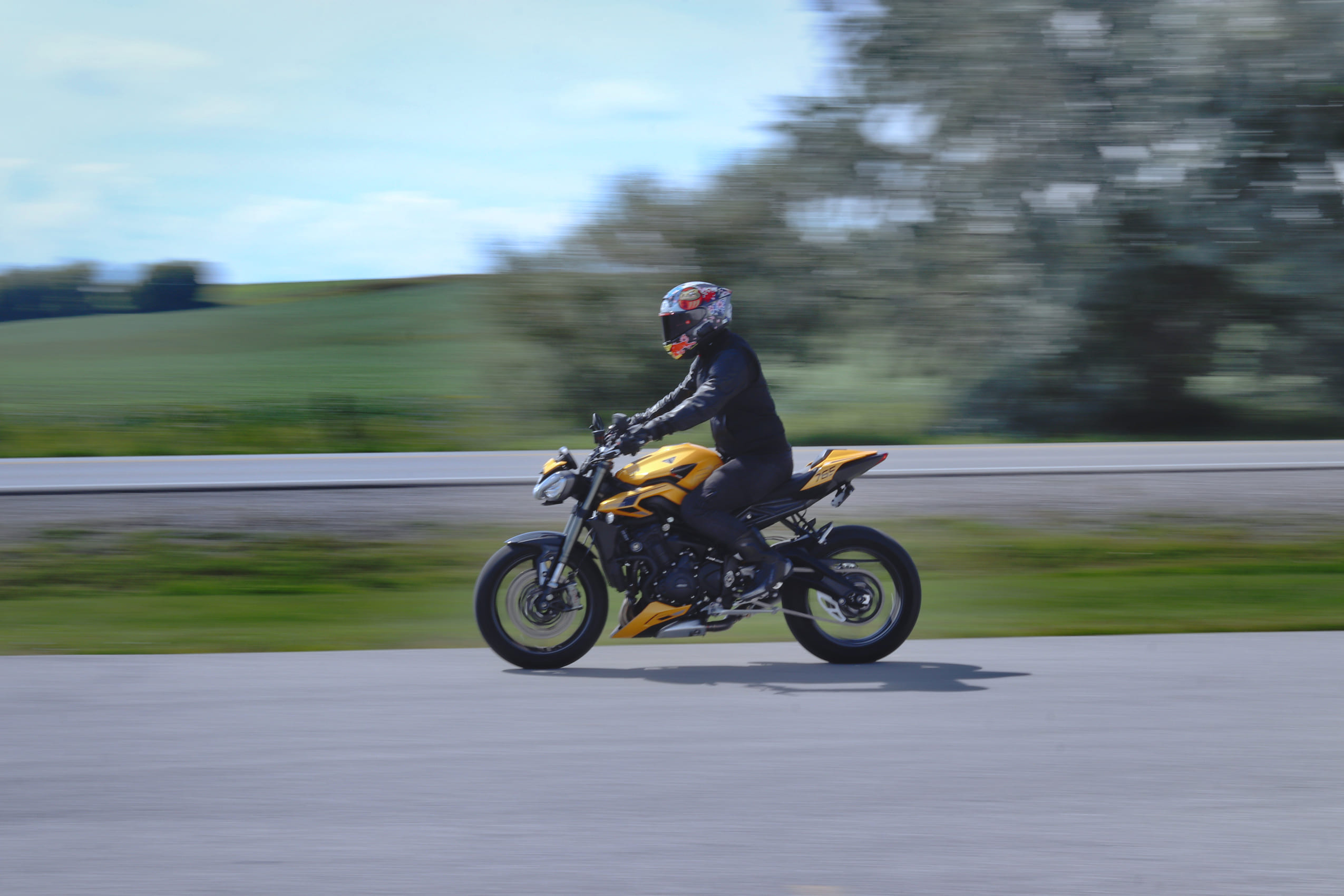
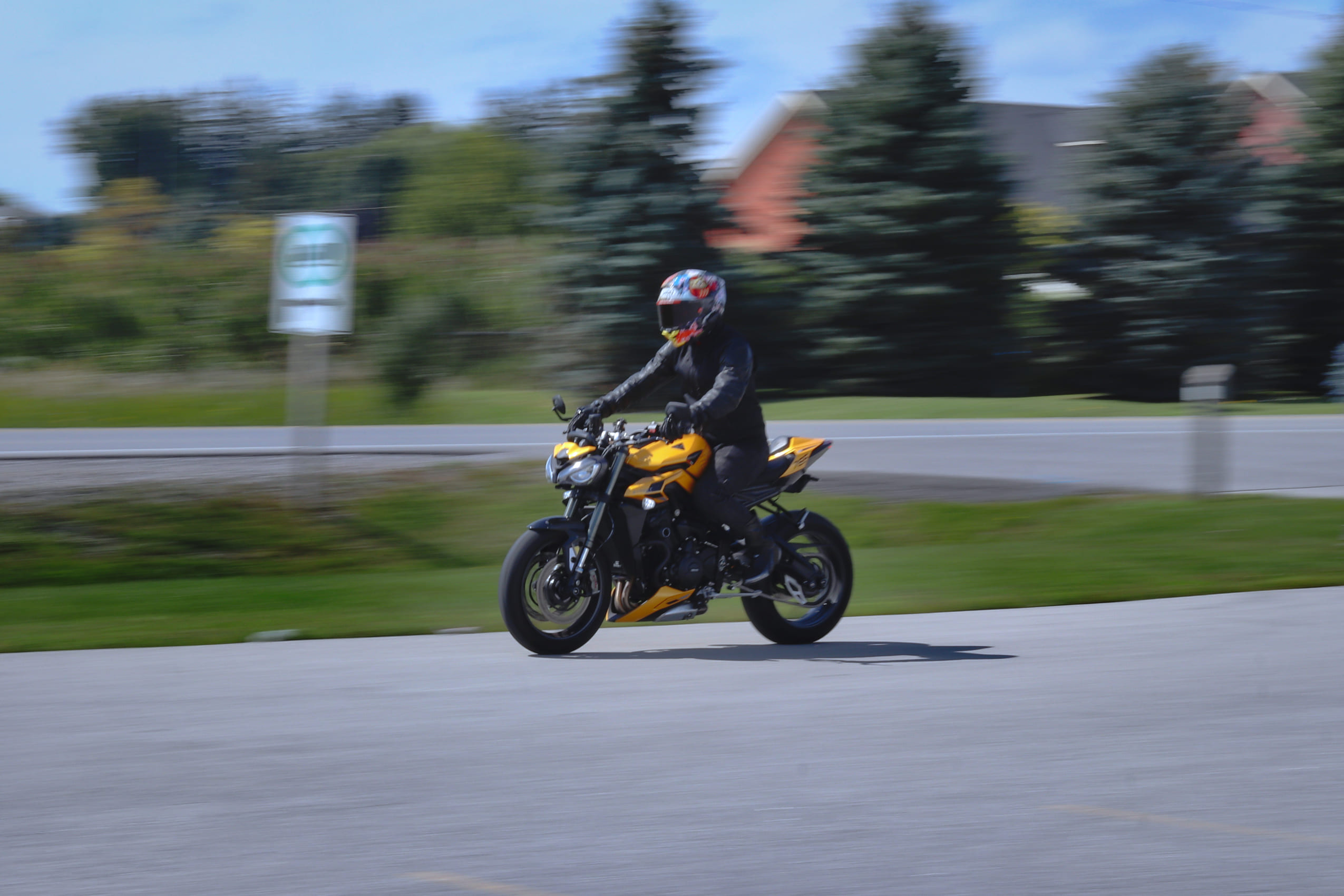
The Triumph responds with the razor-sharp chassis precision and telepathic, buttery throttle delivery that made the Street Triple name famous as the ultimate dual-purpose street-and-track scalpel. Triumph equips the RS with track-ready Pirelli Diablo Supercorsa SP V3 tires right out of the box—an astonishingly sticky compound for hot track days, even if they wear down faster on the street than a set of cheap pencil erasers. Slam on those Stylema brakes, and the Showa front forks dive with reassuring, rock-solid stability under heavy loads. It’s only when you push to a blisteringly fast pace on a circuit that the Showas start to reveal a slightly numb, isolated feedback loop at the front tire contact patch—where the Ducati’s full Öhlins setup proves its worth on track. But back out on public asphalt? The difference between the Showas and the Öhlins front ends vanishes completely, leaving you with two astonishingly capable weapons that make fast riding feel laughably effortless.
So, where does that leave us when the helmet comes off and the dust settles? Despite shedding more than 30 horsepower compared to the screaming, outgoing V2 brute, this new-generation Ducati Streetfighter V2 S is an undeniable triumph of dynamic engineering. By dumping a massive chunk of weight, it has officially matured into a light, hyper-agile, true middleweight weapon—proving that sheer usability and sharp chassis tuning beat outright spec-sheet muscle every day of the week. Even with its lower peak output, the Ducati remains one of the most razor-sharp, track-focused naked bikes money can buy today.
The Triumph, meanwhile, can’t completely hide the gray hairs on its underlying platform, but it holds fast to the magic formula that made the Street Triple an icon in the first place. Its silky-smooth, character-rich triple engine, effortless day-to-day ergonomics, and intuitive road manners make it the absolute benchmark for dual-purpose versatility—a bike as comfortable on the daily commute as it is carving up a track-day fast group. Its dashboard layout may look embarrassingly outdated, but the rest of the package is still formidable enough to give anything in the segment a serious run for its money.
Ultimately, declaring a winner comes down to a fundamental question: are you willing to cut a check for over $5,000 more to park the more advanced, uncompromisingly aggressive Italian in your garage? If money is no object and you crave cutting-edge electronics, exotic pedigree, and maximum track drama, the Streetfighter V2 S is the undisputed king of the hill. But when it comes to raw value for your hard-earned dollar, almost nothing on two wheels can touch the Street Triple RS. If you can live with its annoying cluster, the Triumph delivers 95% of the Ducati’s real-world pace and thrill—alongside superior street manners—for a fraction of the cost.
| Specification | 2026 Ducati Streetfighter V2 S | 2026 Triumph Street Triple 765 RS |
|---|---|---|
| Engine | 890cc V2, 90° Twin, IVT (Intake Variable Timing), Liquid-cooled | 765cc Inline 3-Cylinder, 12-Valve, DOHC, Liquid-cooled |
| Power / Torque | 120 hp @ 10,750 rpm / 69.0 lb-ft @ 8,250 rpm | 128 hp @ 12,000 rpm / 59.0 lb-ft @ 9,500 rpm |
| Fueling | Ride-by-wire electronic fuel injection, oval throttle bodies | Multipoint sequential electronic fuel injection with SAI and Ride-by-wire |
| Front Suspension | 43mm Öhlins NIX30 inverted fork, fully adjustable, TiN treatment | 41mm Showa Separate Function Big Piston Fork (SF-BPF), fully adjustable |
| Rear Suspension | Öhlins monoshock, fully adjustable, aluminum double-sided swingarm | Öhlins STX40 piggyback reservoir monoshock, fully adjustable |
| Front Brakes | Dual 320mm semi-floating discs, Brembo M50 monobloc 4-piston radial calipers, Cornering ABS | Dual 310mm floating discs, Brembo Stylema 4-piston radial monobloc calipers, Optimised Cornering ABS |
| Rear Brakes | Single 245mm disc, 2-piston caliper, Cornering ABS | Single 220mm disc, Brembo single-piston sliding caliper, Optimised Cornering ABS |
| Seat Height | 838 mm (33.0 in) | 836 mm (32.9 in) |
| Curb Weight | 177 kg (390 lbs) wet without fuel / 189 kg (417 lbs) curb | 188 kg (414 lbs) wet |
| Fuel Capacity | 15.0 L (3.96 US gal) | 15.0 L (3.96 US gal) |
| Electronics | 5″ TFT display, 6-axis IMU, Riding Modes, Power Modes, Cornering ABS, Ducati Traction Control (DTC), Ducati Wheelie Control (DWC), Engine Brake Control (EBC), Ducati Quick Shift (DQS) 2.0 | 5″ TFT display, 6-axis IMU, 5 Riding Modes (Road, Rain, Sport, Track, Rider-configurable), Optimised Cornering Traction Control, Wheelie Control, Triumph Shift Assist (Up/Down) |
| Price (MSRP) | ~$21,495 CAD / $17,995 USD | $15,195 CAD / $12,795 USD |
| Website | ducati.com/ca/ | triumph-motorcycles.ca |
British Precision vs. Italian Violence: 2026 Ducati Streetfighter V2S vs.
Human beings are inherently absurd creatures, but nowhere is that absurdity more evident than in our willingness to strap our…

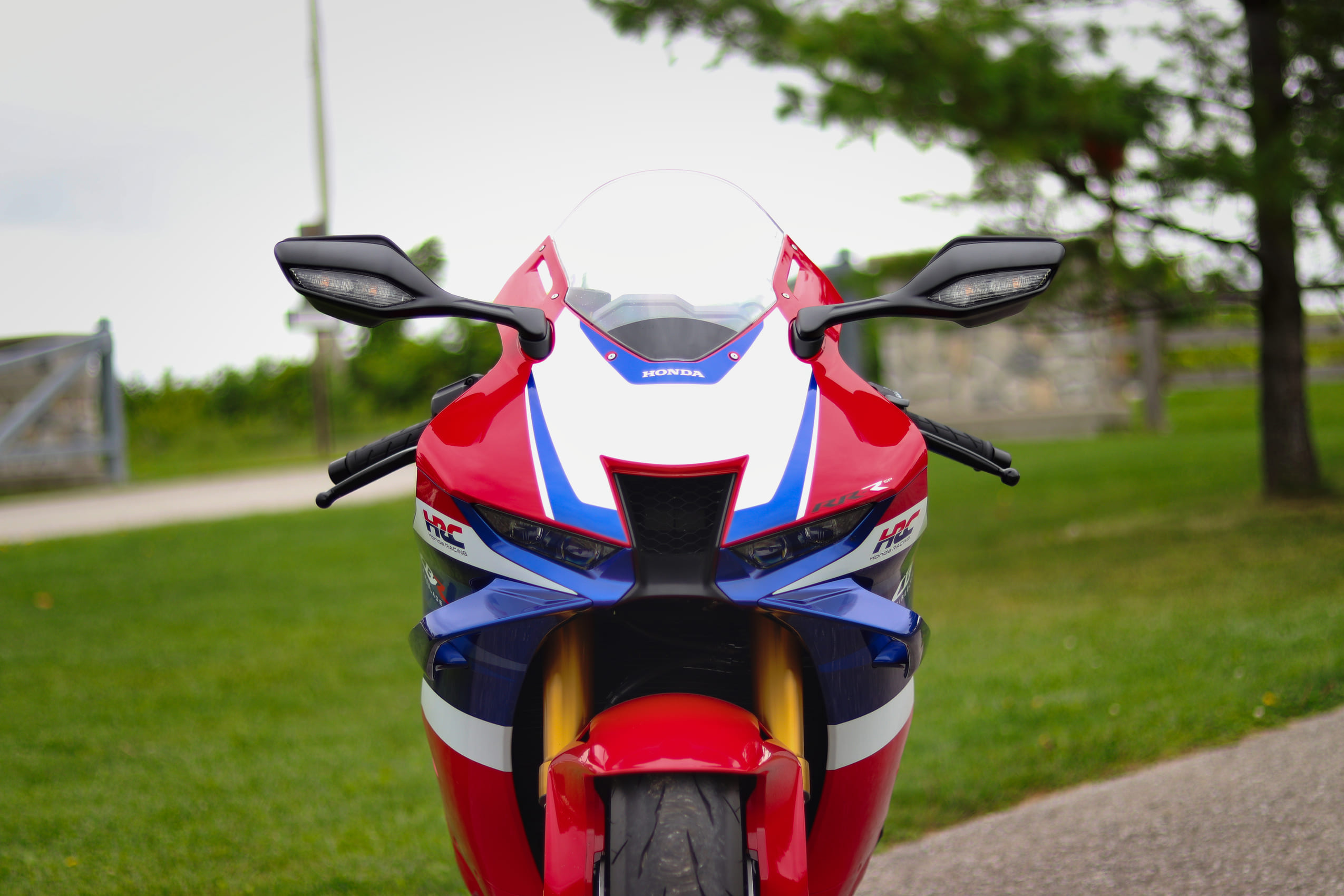
2026 Honda CBR1000RR-R Fireblade SP Review: Pure Mechanical Violence
The 2026 Honda CBR1000RR-R Fireblade SP is not a motorcycle; it is a clinical, unrelenting exercise in absolute mechanical insanity…
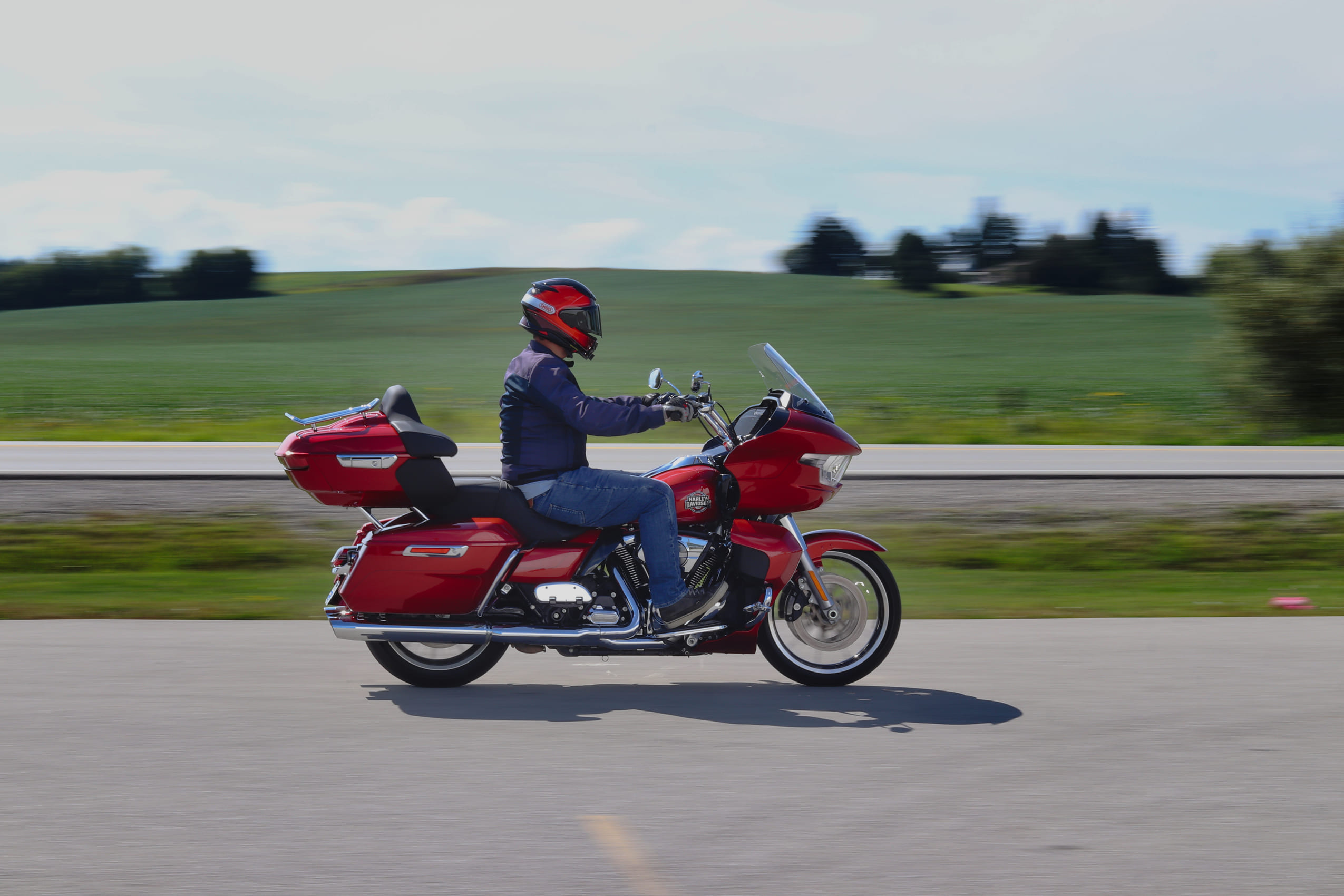
Sharknose Supremacy: Driving the 2026 Harley-Davidson Road Glide
Let’s get one thing straight: the 2026 Harley-Davidson Road Glide shouldn’t make sense. It’s a rolling, 800-pound contradiction—a massive, frame-mounted…
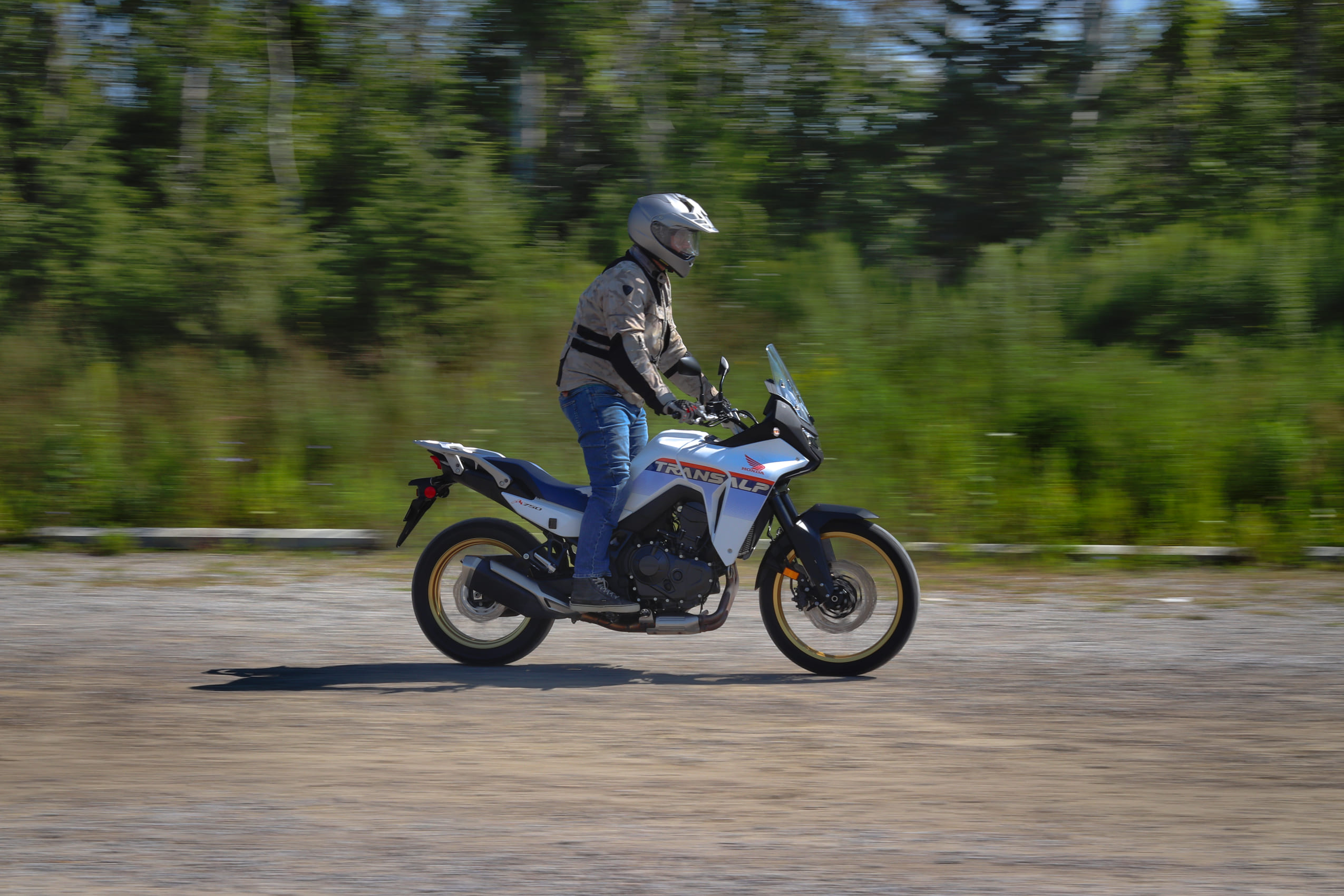
The Anti-ADV Hero: Why the 2026 Honda Transalp is the
Leave it to Honda to look at the entire, absurdly over-engineered, $25,000 middleweight adventure segment—a market flooded with hyper-focused rally…
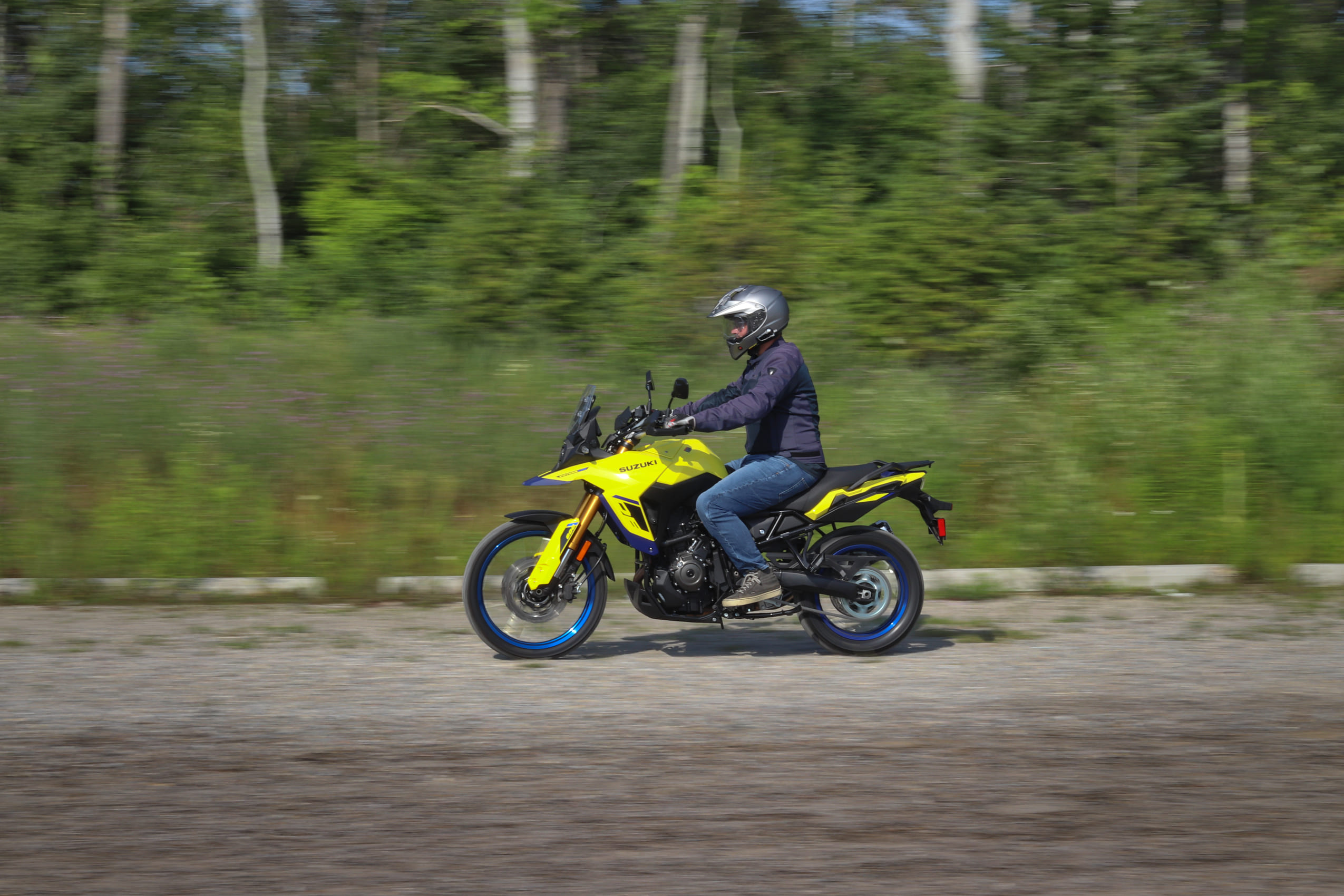
2026 Suzuki V-Strom 800DE: No V-Twin, No Problem
Words are supposed to mean things. The “V” in V-6 means a V-layout, and for two decades, the “V” in…
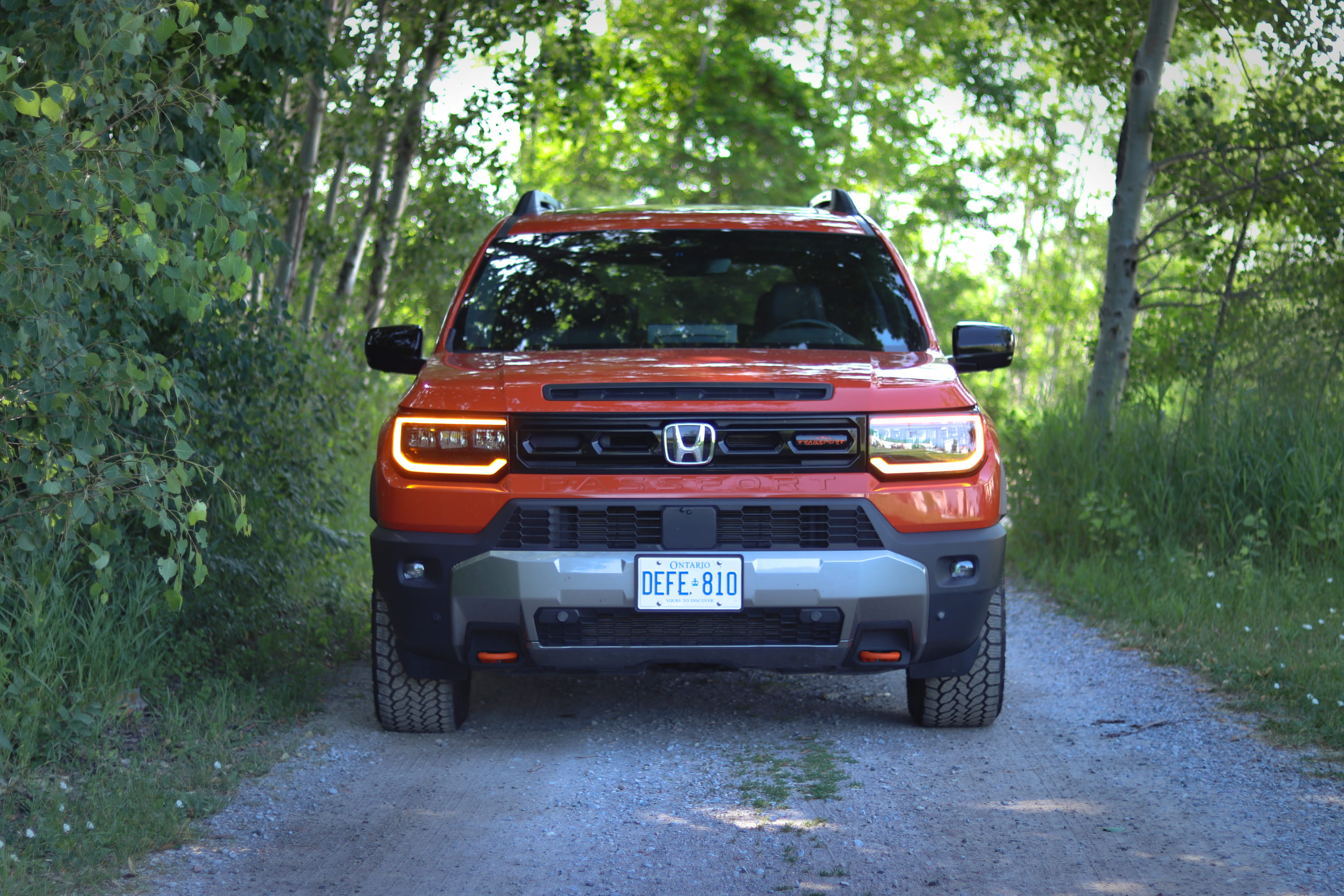
2026 Honda Passport TrailSport Review: The World’s Most Charming Anti-Wrangler
Let’s be honest about what’s actually happening here. Honda knows as well as you do that nobody is taking a…